

Life at Da Vinci
School trip to Micropolis, the City of Insects
16 October 2025
On Thursday 9 October 2025, the whole school, from pre-school to primary, set off for the Aveyron. The destination: Micropolis, la cité des insectes, the “City of Insects”, in Saint-Léons, near the Millau Viaduct, an hour and a quarter from Montpellier.
This was the big start-of-year trip. Arriving at 10 am and leaving at 3.30 pm, the children spent the day with insects, including an hour-long workshop with live stick insects.
“Face aux phasmes”: an hour with live stick insects
Of the workshops Micropolis offers schools, the teaching team had chosen “Face aux phasmes”, which means “face to face with stick insects”. The City of Insects describes it as an encounter with tropical stick insects: the children observe them, hold them, and learn about their life cycle, their moulting and the way they defend themselves.
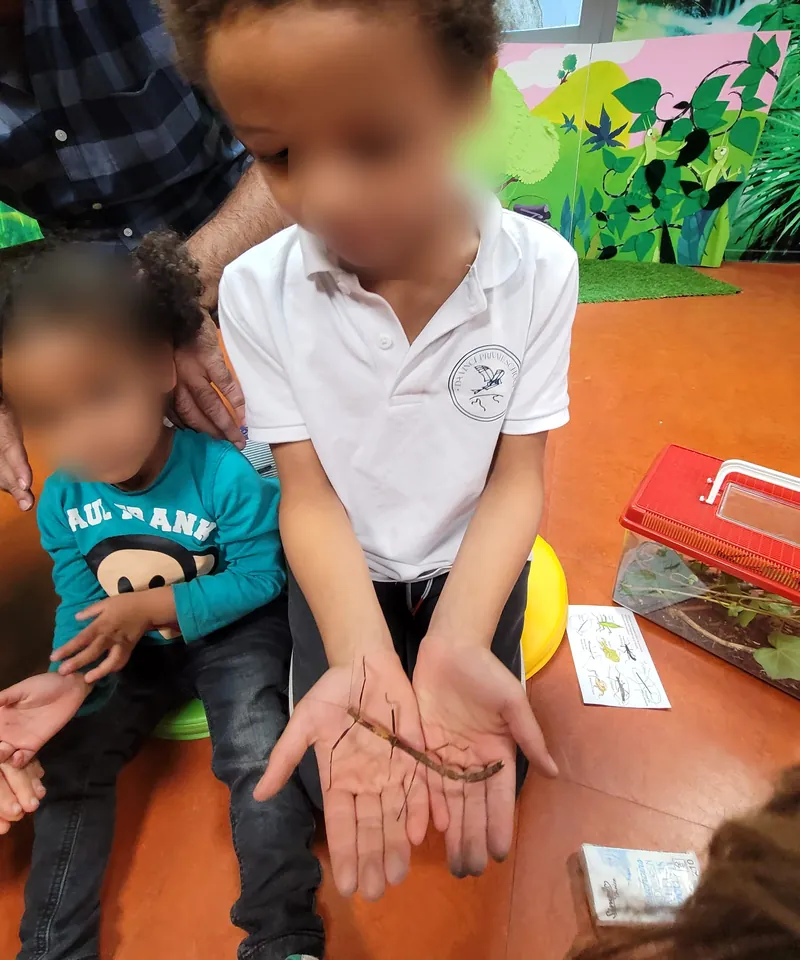
Sitting on the floor of the workshop room, around small terrariums, the children watched insects being passed around that you could easily mistake for twigs. It takes a moment to make out the head, the antennae and the six legs, so well does everything blend in with dry wood.
The children were then able to hold one in the palm of their hand. To do this, you keep your hands open and flat, without squeezing and without sudden movements. The stick insect walks slowly, placing one leg after another, and all you have to do is let it. An illustrated sheet on the floor helped the children find the name of each species they were shown.
Holding a living animal, however small, takes attention and a little patience. It is also a way of understanding that it is fragile, and that you respect it by handling it gently.
The leaf insect, which looks just like a leaf
One of the insects on show looked nothing like a twig: the leaf insect. Its body is flat and bright green, with jagged edges like a leaf and a line down the middle that looks like a vein.
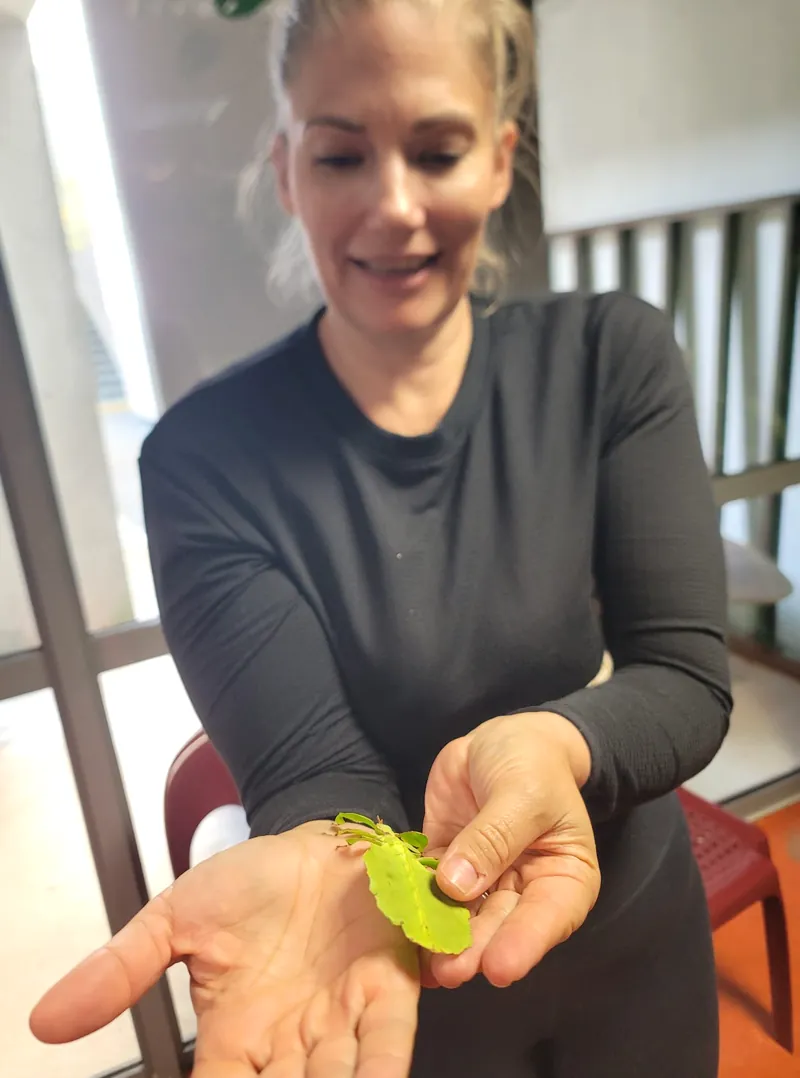
Set down on a plant, it vanishes. That is the whole idea of camouflage: looking like your surroundings so that whatever might eat you does not spot you. Stick and leaf insects have made it their speciality. More than 3,000 species are known, mostly in tropical regions, and most of them imitate a branch or a leaf. Some even sway gently, like a twig in the wind.
When camouflage is not enough, other strategies take over. The insect stays perfectly still, until it passes for a piece of dead wood. If it is caught by a leg, it can shed that leg to escape; in young insects, the leg grows back over the following moults.
Why does this insect look like a leaf? What does that do for it? What would happen to it on a white wall? Faced with the animal itself, these questions come naturally.
Observing, comparing, trying to understand
A living insect makes you look closely. You count the legs, compare two stick insects, notice that one is brown and the other green, and wonder why.
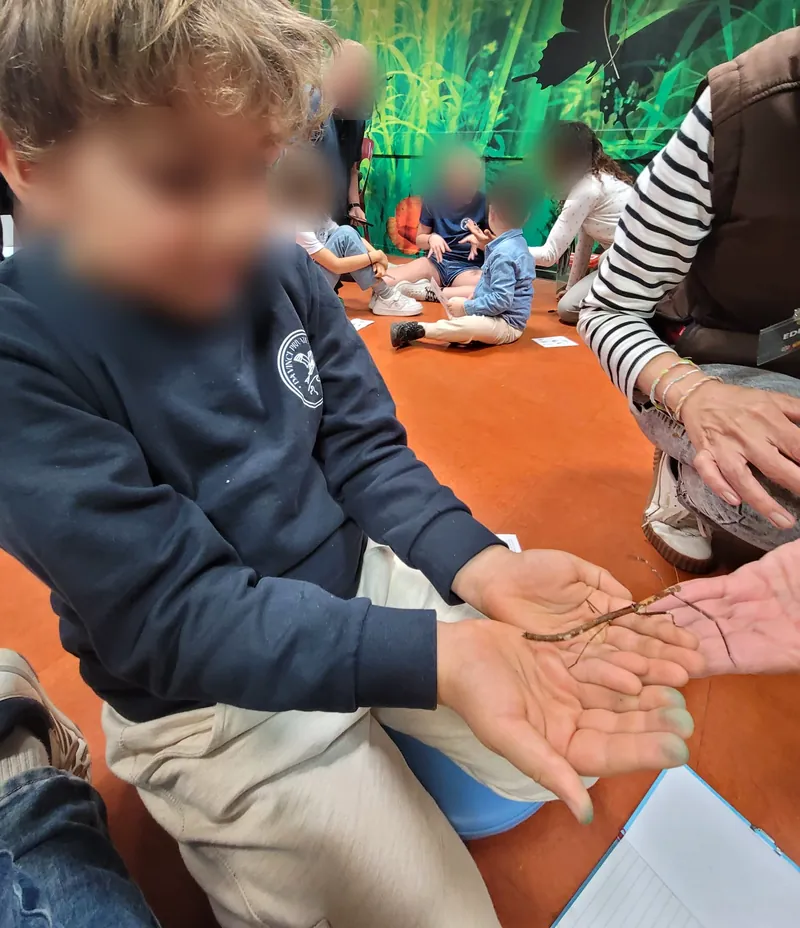
This is where a scientific approach begins: observe, compare, form a hypothesis, then test it. Children practise it before they even know what it is called.
Moulting is a good example. Like all insects, the stick insect has its skeleton on the outside of its body, a kind of rigid armour that does not grow with it. To grow, it has to shed it several times in its life: it wriggles out of its old casing, leaves it behind, and waits for the new one to harden. Our skeleton, on the other hand, is on the inside and grows with us.
The life cycle holds another surprise. In many species of stick insect, females can lay eggs that hatch without any male involved: this is called parthenogenesis. The eggs even look like tiny seeds. Easy to feed, with a few bramble or ivy leaves depending on the species, stick insects are among the few insects that can be kept in a classroom to follow this cycle week by week.
Stick insect, predator, prey: the words in French and English
In a bilingual school, a trip like this one feeds both languages. In French, the stick insect is a phasme and the leaf insect a phyllie. Camouflage is camouflage in both languages. The predator is the prédateur, the prey the proie, and the life cycle the cycle de vie.
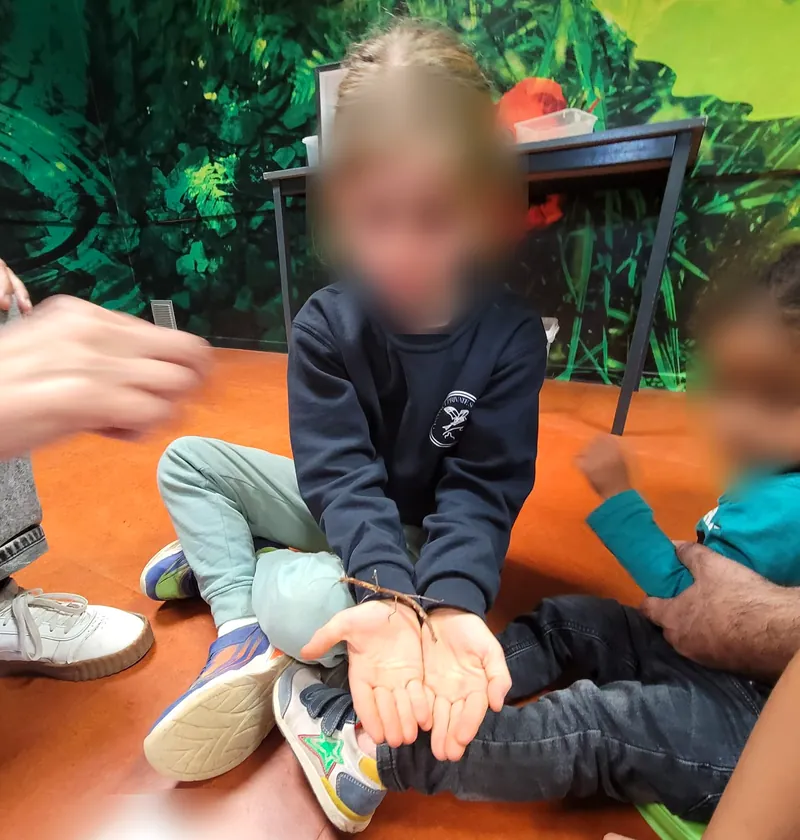
These words stick far better after a real experience than from a list. Hearing stick insect while looking at one, then phasme a moment later, ties both words to the same image, the one the child has just held. A child who has held a stick insect in their hand knows what they are talking about, in one language as in the other. That is what bilingual immersion makes possible: language attaches to what you have seen and done.
A word like “camouflage” or “moulting” carries a different weight once you have held the animal in your hand. That is the principle of active learning: start from a real experience, and let curiosity do the rest.
Outside, on the paths around the City
The day was not spent indoors only. Around the building, Micropolis has outdoor areas among the hills of the Aveyron: paths, illustrated boards, picnic areas and playgrounds.
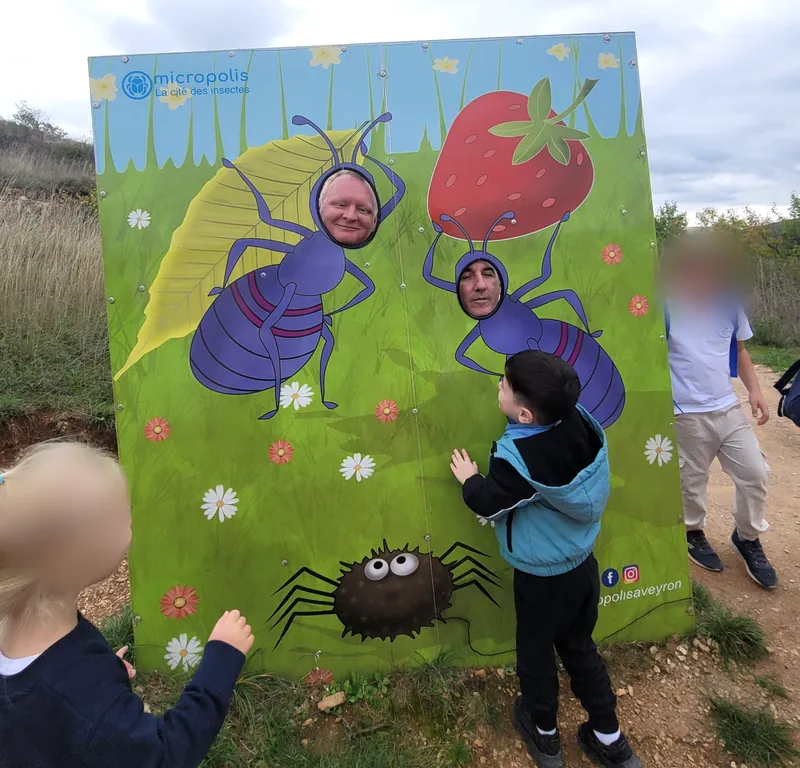
In front of a large board illustrated with ants, two of our teachers joined in the fun and put their heads through the holes, with the children looking on.
This time outdoors matters as much as the workshop. The children run, tell each other what they have seen, and enjoy being together away from the classroom.
Younger and older children, one day together
The trip brought together the whole school, from pre-school to primary. In one of the photos, a pre-school child watches an older one holding a stick insect: you also learn by watching others.
For the youngest, a stick insect is a good first encounter with insects: a calm, slow animal you can look at very closely and sometimes touch. A way to make friends with a creature that can seem a little frightening from a distance.
The youngest discover a new place alongside older children. The older ones look out for the little ones, wait for them, and show them what they have just seen.
Two big trips a year for the whole school
On top of the weekly outings, the teaching team organises two trips each year for the whole school: one at the start of the year, the other at the end.
Micropolis opened the 2025-2026 school year. A second trip will bring the whole school together before the summer.
Find out more about our teaching programme, our bilingual pre-school and our bilingual primary school.
Ready to discover the Cocon d'Évolution?
The micro-campus welcomes 45 children in total. Take the time to talk with us and see whether the school is right for your child.
Apply for Admission