


Ages 6 to 10 · CP to CM2
Bilingual primary school in Castelnau-le-Lez
Da Vinci Private School's primary school welcomes children aged 6 to 10, from CP to CM2, in Castelnau-le-Lez, on the edge of Montpellier. Teaching is in French and in English, in equal measure, in classes of no more than 15 children.
Two curricula brought together
The school follows an international curriculum developed over some sixty years and taught in schools around the world. It is cross-disciplinary — mathematics comes up in science, geography in music — and includes the essential points of the French national curriculum. A child can therefore go on to a French secondary school just as easily as to an international one. Discover the curriculum.
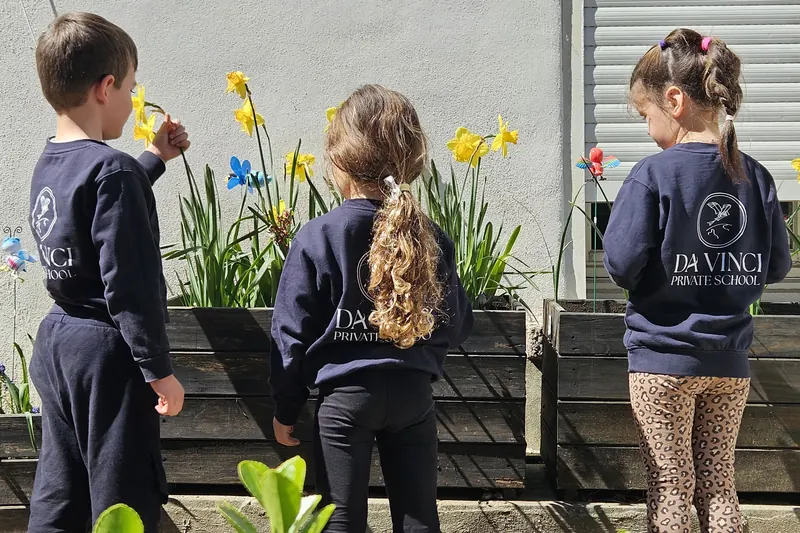
Solid foundations, in two languages
Reading, writing, grammar and spelling, mental arithmetic, mathematical concepts, written work and presentations: the fundamentals are practised every day. Half of school time is in French and half in English, with a teacher for each language. In the older classes, children work as young researchers, and peer tutoring builds curiosity, critical thinking and analytical skills. How children learn here.
15 children per class, never more
The campus welcomes 45 children in total. With 15 children per class, the teacher knows each child's level, forms groups of similar level and adjusts teaching through the week. No child goes unnoticed — neither the one who is struggling nor the one who is bored.
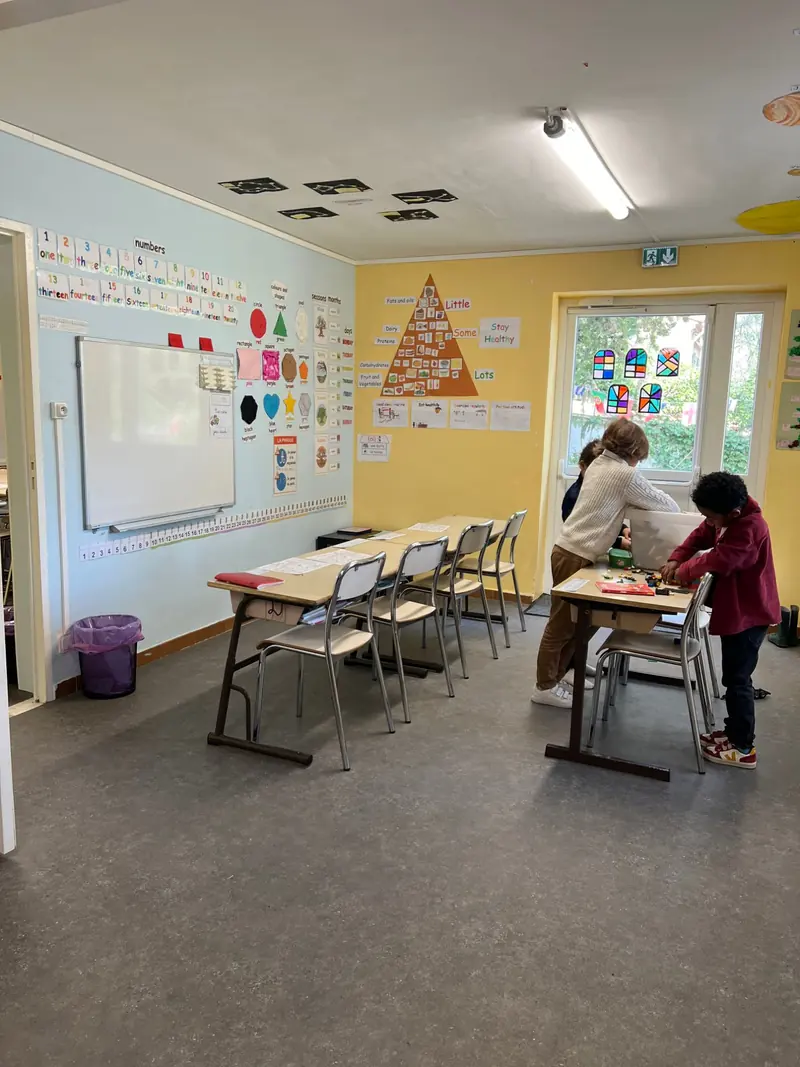
Assessment that measures progress
No marks out of 10 or 20, which highlight gaps rather than progress. Each year has three stages of assessment: a diagnostic assessment at the start of the year, formative assessment day to day (quizzes, presentations) and a summative assessment at the end of the year. Parents receive a bilingual report each term, with individual comments. More about assessment.
Outings every week
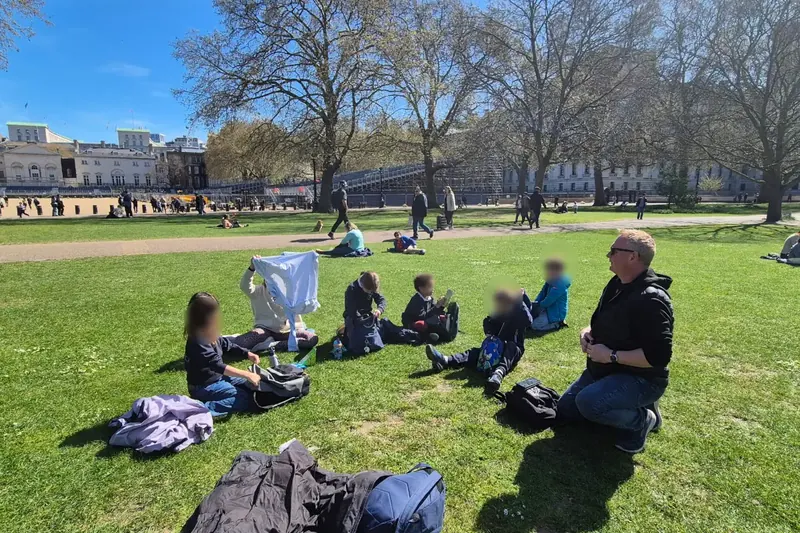
At least once a week, children leave the school for an outdoor learning trip: the forest, the beach, the library…
The school day, 7.45am to 6pm
The campus is open Monday to Friday from 7.45am to 6pm, and until 4.30pm on Wednesdays, with lunch served at school. Before- and after-school care, meals and the Wednesday afternoon Da Vinci Club, in English, are chosen as optional extras. What the fees cover and what comes on top.
Getting to school
The campus is at 69 rue des Églantiers, Castelnau-le-Lez. Families come from Montpellier and the neighbouring towns: Le Crès, Jacou, Clapiers, Vendargues, Saint-Aunès, Montferrier-sur-Lez, Saint-Clément-de-Rivière, Saint-Drézéry. Directions and contact.
Applying for primary school
Joining during primary school, from CP to CM2, is discussed with each family. Everything starts with a visit to the campus, by appointment, followed by a first conversation with the team. Applying is free, and you are given the fees at that first conversation.
Your child is not yet 6? See the bilingual pre-school, ages 2 to 5.
Ages 2 to 11
Children welcomed
15
Children per class, maximum
Inspected
By the Inspection Académique de l’Hérault
Ready to discover the Cocon d'Évolution?
The micro-campus welcomes 45 children in total. Take the time to talk with us and see whether the school is right for your child.
Apply for AdmissionFrequently asked questions
What is the difference between "école primaire" and "école élémentaire"?
Strictly speaking, "école primaire" covers the whole of French primary education: the pre-school years ("école maternelle", from the pre-nursery year to the final pre-school year) and "école élémentaire" (CP to CM2). In everyday French, though, "primaire" almost always means CP to CM2 — the word parents use, and the one this site uses. So when we talk about our primary school, we mean CP to CM2. Da Vinci Private School covers the whole of primary education, from pre-nursery to CM2.
What is a "cycle" in French schools?
Since 2016, French schooling has been organised in three-year cycles, and the curriculum sets what must be learned by the end of each cycle rather than each year. Cycle 1 is the pre-school years. Cycle 2 covers CP, CE1 and CE2. Cycle 3 covers CM1, CM2 and the first year of secondary school (sixième). At Da Vinci Private School, children follow cycles 1 and 2 and the first two years of cycle 3.
Private or state primary school: what should I compare before choosing?
Class size, how much time each language really gets in the week, how progress is assessed and shared, and which curriculum is followed. At Da Vinci Private School: no more than 15 children per class, half of the time in English, no marks out of 10 or 20 but a bilingual report each term, and an international curriculum that includes the requirements of the French national curriculum.
Read more: How to choose a primary school: the 15 criteria that really matter
My child doesn't speak English: can they join a bilingual primary school?
Yes, each arrival is discussed with the family. A diagnostic assessment measures the child's level on arrival, and groups of similar level support them while they grow confident in their second language.
Read more: At what age should a child start learning English?
What is the difference between a bilingual school and a school with "extra English"?
In a school with extra English, English remains a subject taught a few hours a week. In a bilingual school such as Da Vinci Private School, English is a language of instruction: half of school time is in English, with a dedicated teacher.
Read more: Bilingual immersion or English lessons: what difference for a child?
Does an independent school award a qualification at the end of CM2?
No primary school in France, state or private, awards a qualification at the end of CM2: the first national qualification is the brevet, at the end of lower secondary. What matters in primary school is tracking what has been learned. At Da Vinci Private School, that means a bilingual report each term, designed to meet both the international curriculum and the French national curriculum.
After a bilingual CM2, what are the options for secondary school?
A state or private collège, an international section or a bilingual class where the collège offers one, or an international school. Admission arrangements depend on each school and should be checked with it.