

Life at Da Vinci
Life-saving skills: a first aid workshop at school
16 October 2026
What should you do if someone collapses in front of you? Which number do you call? What do you tell the emergency services? And what if someone is choking?
These questions are daunting, even for adults. Yet a few reflexes are often enough to change the course of an emergency, and they can be learned early.
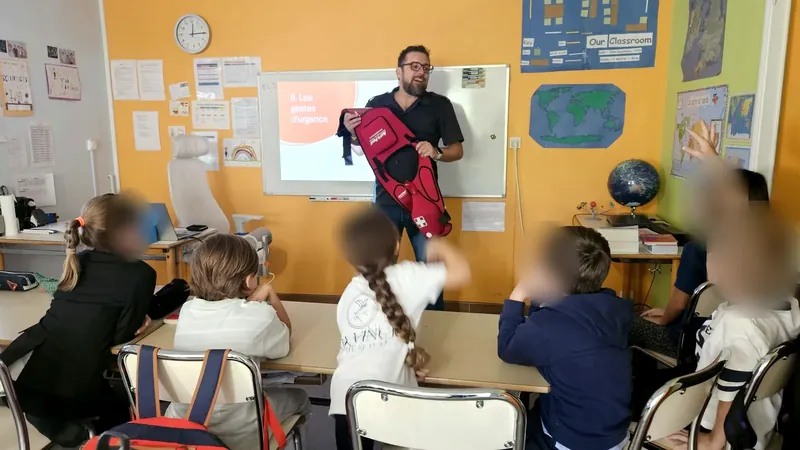
Jonathan Filiu, a safety trainer at Dolbi, came to Da Vinci Private School to run a first aid awareness workshop. On the programme: emergency calls, recognising when someone is unwell, what to do when someone chokes, and role-plays.
The idea behind the session fits in one sentence: everyone, at their own level, can help someone in trouble.
15, 18, 112… and 114
In France, 18 and 112 come to mind first. 15 and 114 much less so. The children found out what each one is for:
- 15: the SAMU, for medical emergencies;
- 18: the fire and rescue service;
- 112: the European emergency number, valid in every EU country;
- 114: a number you can reach by text message, video call or an app. It lets deaf and hard-of-hearing people contact the emergency services, and also anyone who cannot speak out loud without putting themselves in danger.
That last number is worth knowing. Sometimes calling is impossible, or risky: being able to write your message then changes everything.
For parents: 17 (police) completes the list.
Knowing what to say matters just as much. The children practised the three things the emergency services need: what is happening, where the person is, and what help they need. They also learned how to make an emergency call from a locked phone, without the code.
The main rule: speak as clearly as you can, answer the questions, and don’t hang up until you are told to.
Feeling scared at such moments is normal. Having thought about it beforehand helps you find your bearings.
Role-playing a collapse to learn how to react
Theory is not enough. Facing a situation, even a pretend one, makes you think for real.
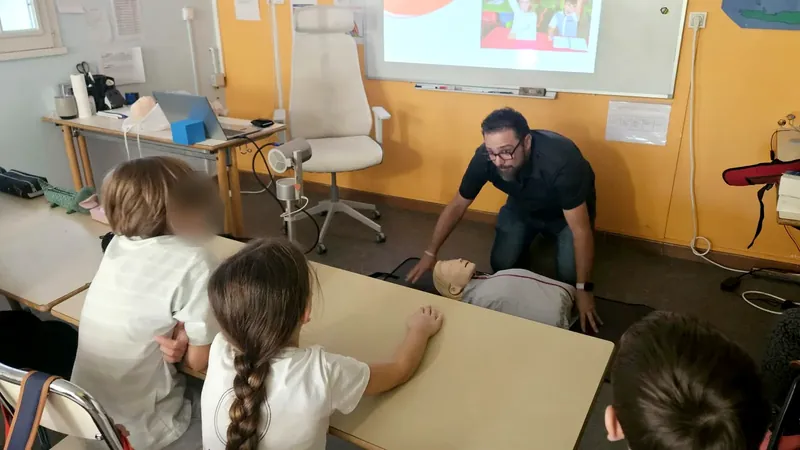
The children took part in role-plays of someone feeling unwell. Is the person conscious? Are they breathing normally? Should we call for help? They learned that everything starts with observing.
They also discovered the recovery position, used when a person is unconscious but breathing normally, while waiting for the emergency services.
Choking: not every case is the same
What should you do when someone is choking? It depends first on how serious it is.
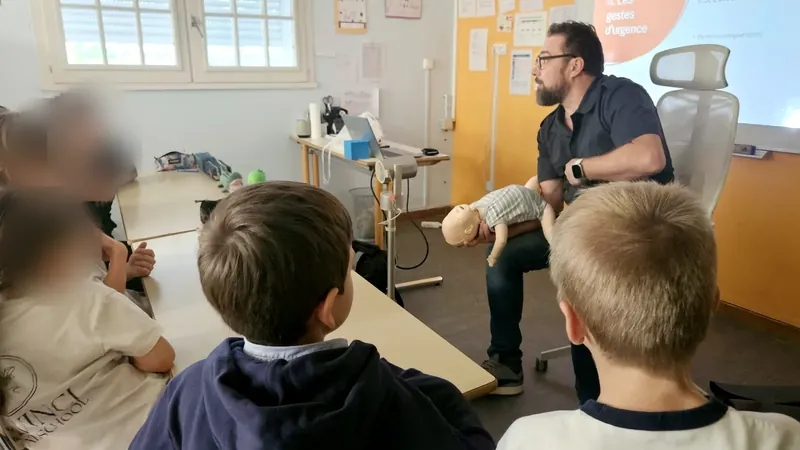
When the airway is partially blocked, air still gets through: the person coughs, talks, breathes with difficulty. You encourage them to keep coughing and do not intervene. When it is completely blocked, the person can no longer speak, cough or breathe: you must act at once.
Jonathan Filiu showed how the technique changes with age. For adults and older children, you alternate back blows with abdominal thrusts, the Heimlich manoeuvre. For babies, the thrusts are given on the chest, never on the tummy.
Using the same technique on everyone would be a mistake. What matters first is recognising the signs, raising the alarm quickly and getting help.
Helping doesn’t mean doing everything alone
A fall, a serious injury, someone losing consciousness: these situations are frightening. A few principles apply to all of them: don’t put yourself in danger, alert the emergency services, describe what you see and follow the instructions.
This was the message the workshop repeated most. Helping someone does not mean knowing how to do everything yourself. A child can raise the alarm, pass on information, fetch an adult. That is not a minor role: it is often the most useful one.
Knowing your limits is part of acting responsibly. For a child, understanding that they can be useful without carrying a serious situation alone is as reassuring as it is preparing.
What hands-on practice brings
First aid is hard to learn from a book. During a role-play, a child does not just memorise information: they observe, decide what to do and understand why. They listen, reason, communicate, and learn to stay calm when emotions run high. They can also ask questions and make mistakes without consequences.
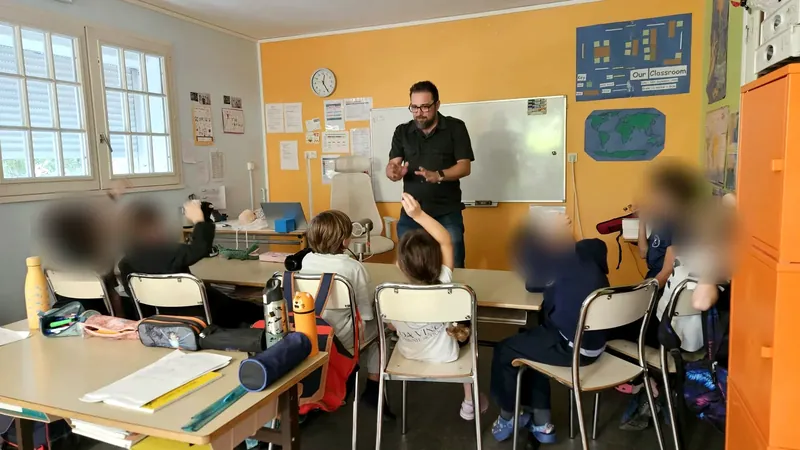
That is how we see active learning: connecting what children learn to real situations.
We often link independence to getting dressed alone or packing a school bag. But an independent child is not a child who handles everything alone. It is a child who takes sensible initiatives and knows who to turn to. Calling the right number, describing what they see, alerting an adult: these are already ways of acting, and of building self-confidence.
These reflexes are not just for children, by the way. Adults have every reason to refresh them regularly.
A certificate to mark the day
At the end of the workshop, each child received a certificate of participation. It is not a first aid qualification and does not replace one. It is a way of recognising their involvement in a subject that concerns us all.
A big thank you to Jonathan Filiu and Dolbi for this session, for the role-plays and for everything he shared with the children.
Caring for others can be learned early
Teaching children first aid does not mean handing them adult responsibilities. It means giving them landmarks suited to their age: recognising a worrying situation, raising the alarm, asking for help.
Learning life-saving skills is also learning to care for others.
Discover our teaching programme, our bilingual pre-school and our bilingual primary school.
Ready to discover the Cocon d'Évolution?
The micro-campus welcomes 45 children in total. Take the time to talk with us and see whether the school is right for your child.
Apply for Admission