


Understanding our approach
Active learning: what it really is, and how children learn
3 March 2026
Learning is not only about listening, memorising and repeating information.
A child also learns by searching, experimenting, making mistakes, asking questions, testing their ideas against other people’s and trying to find solutions for themselves.
That is exactly what active learning sets out to develop.
But this now-familiar expression covers very different realities. A fun activity is not enough to make active learning, any more than simply working in groups.
So what exactly is active learning? How does it work? What are its strengths and its limits? And above all, what does it change, in practice, in the way a child learns?
What is active learning?
Active learning is an approach in which the child takes an active part in building their own knowledge, rather than only receiving information passed on by the teacher.
A more traditional approach can often be summed up like this: teacher → transmission → child → memorisation → assessment.
Active learning aims instead to create a loop: experience → questioning → research → reflection → understanding → application.
The child is not simply asked to remember an answer. They are led to understand how to reach that answer.
This does not mean the teacher disappears or that the child learns alone. Quite the opposite: the teacher’s role becomes essential.
The teacher designs learning situations, asks questions, supports the child’s research, brings the knowledge needed and helps the child organise what they have just discovered.
The aim is not to leave the child to “figure it out”, but to give them, step by step, the means to take charge of their own learning.
The main principles of active learning
Active learning can take very different forms depending on the school and the teacher. Several principles, however, come up again and again.
1. The child takes an active part in learning
A child generally remembers more when they understand why they are learning something and can use it in a real situation.
Instead of simply learning a rule, they might be faced with a problem to solve.
Instead of being handed a scientific explanation, they might start by observing a phenomenon, forming hypotheses and trying to understand what is happening.
That does not make the child their own teacher. They are still guided by a professional who knows what must be learned and how to lead the child there.
2. Curiosity drives learning
Children naturally ask a great many questions. Why? How? What if…? What would happen if we did it differently?
Active learning uses this curiosity as a starting point.
A child’s question can become the opportunity for research, an experiment, some reading, a discussion or a project.
What is at stake matters: it is not just about getting the right answer, but about gradually building the reflex of trying to understand.
3. Mistakes are part of the process
In active learning, getting something wrong is not necessarily a failure. A mistake can provide valuable information:
- What had the child understood?
- Where did their reasoning stop?
- Which hypothesis was wrong?
- What can be changed?
- What new strategy can be tried?
The aim is obviously not to let a mistake take root. The teacher must spot it, help the child understand it and help them build a more accurate picture.
The child thus learns, little by little, that a difficult problem is not necessarily a sign that they cannot succeed. It may simply mean they need to change strategy.
4. Understanding rather than just memorising
Memorisation remains essential. It would be wrong to set active learning against knowledge.
A child needs knowledge to think, solve problems, read, write, calculate and understand the world around them.
The difference lies more in how that knowledge is used. Memorised information can quickly be forgotten if the child does not understand what it is for. When knowledge is linked to an experience, a problem or a project, on the other hand, it can take on more meaning.
Active learning does not try to do away with memorisation. It tries to give it meaning and a practical use.
Learning through experience
One of the most distinctive principles of active learning is learning through experience.
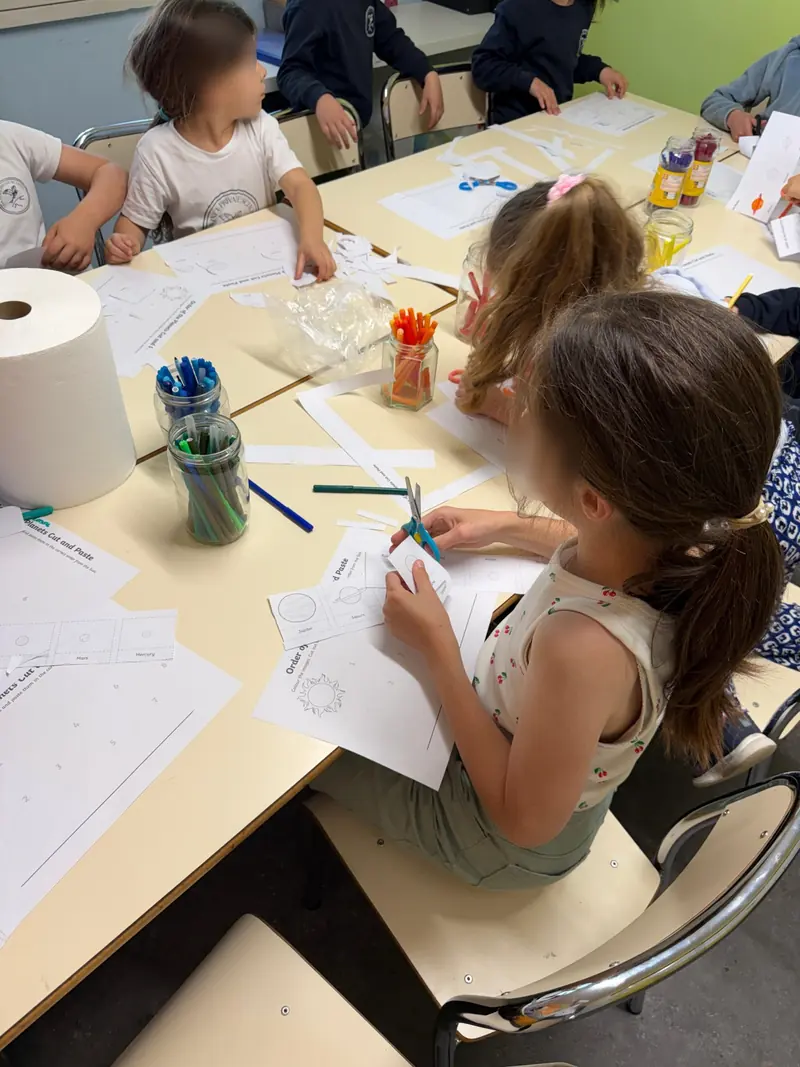
Take a very simple example. A child needs to understand some ideas about plants.
One approach is to present the facts to be learned directly.
Another is to have the child observe different plants, form hypotheses about what they need, set up an experiment, observe the results and then discuss what they mean.
The child then goes through a series of steps: experience → observation → question → hypothesis → research → conclusion → new application.
This process builds several skills at once:
- observing;
- questioning;
- forming a hypothesis;
- looking for information;
- analysing;
- communicating;
- drawing a conclusion;
- reusing what has been learned.
That is one reason why projects and hands-on experience play an important part in some forms of active learning.
Project-based learning
Projects are one possible form of active learning. A project brings several areas of learning together around a real situation.
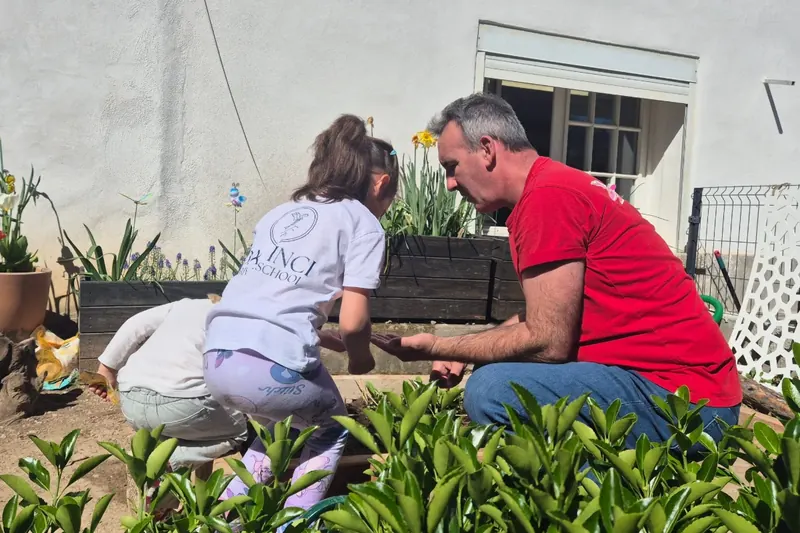
For example, children might have to imagine, build and present something. To do so, they may need to:
- read documents;
- write;
- do research;
- measure;
- calculate;
- work as a team;
- organise their work;
- solve problems;
- present their results.
Knowledge is then no longer kept in separate boxes. It becomes a set of tools for achieving something.
This can also give the child a more concrete sense of why they are learning.
Does the teacher’s role change?
Yes, but it certainly does not disappear. This is a common misunderstanding about active learning.
Thinking that active learning means handing children an activity and letting them experiment without intervening would be a mistake. The teacher’s role actually becomes especially important. The teacher must, among other things:
- set learning objectives;
- design learning situations;
- observe the children;
- identify their difficulties;
- ask the right questions;
- bring the knowledge needed;
- correct mistakes;
- help organise discoveries;
- assess progress;
- adapt their support.
The teacher is therefore not simply someone who passes on information. They also become a guide and a designer of learning situations.
Is active learning always better?
Beware of slogans. Active learning is not a magic formula.
An interesting activity is not automatically an effective one. A fun project does not guarantee that children have really learned something.
Effective active learning must stay structured. The child must know what they are trying to understand or achieve. The activity must have a clear learning objective. The teacher must be able to step in when the child gets stuck and check what has really been learned.
There are also times when direct teaching is entirely appropriate. When a child needs to learn a precise concept, memorise vocabulary, understand a rule or acquire new knowledge, a clear explanation from the teacher may be the best solution.
The real question is probably not choosing between “lecture-style teaching” and “active learning”, but knowing which method to use, when, and for what kind of learning.
Active learning and individualised teaching: an important link
Not all children learn in exactly the same way or at the same pace.
In a class, some will grasp an idea quickly while others will need more explanation, or a different experience, to reach the same result.
Active learning situations can let the teacher observe much more closely the strategies each child uses. Two children can reach the same correct answer through completely different reasoning. Conversely, two children who make the same mistake may have very different difficulties.
Observation therefore becomes an important tool for adapting support. That is where active learning and individualised teaching can complement each other.
What benefits can we look for?
When it is done well, active learning can help develop:
- Independence: the child gradually learns to look for solutions, organise their work and take initiative.
- Problem-solving: it is no longer just about recognising an answer already learned, but about choosing a strategy for a new situation.
- Critical thinking: the child is encouraged to question information, compare possibilities, justify their reasoning and tell a hypothesis from an established fact.
- Communication: projects and group work offer many chances to explain an idea, listen to others, argue a point and present a result.
- Perseverance: when a problem has no obvious solution, the child can learn to try another way rather than give up at the first hurdle.
- Curiosity: learning can become associated with searching and discovering more than with simply repeating information.
Active learning: common misconceptions
Several shortcuts are worth avoiding.
- “Active learning = learning through play.” Not exactly. Play can be a teaching tool, but active learning is much broader.
- “Active learning = less work.” Not at all. A child can be far more mentally engaged when solving a problem than when simply copying information.
- “Active learning = no lessons.” Wrong. Direct teaching of knowledge can have its place in active learning.
- “The child learns on their own.” No. The teacher’s support remains fundamental.
- “A school that uses projects automatically practises active learning.” Not necessarily. What matters is what the child really learns through the project, and how the teacher designs and supports the activity.
What might a day based on active learning look like?
There is, of course, no universal typical day. But one could imagine a sequence like this:
- A question is asked.
- The children say what they think they already know.
- They form hypotheses.
- They research or experiment.
- They compare their results.
- The teacher brings the knowledge needed.
- The children organise what they have learned.
- They use this new knowledge in another situation.
This cycle can repeat on different scales, from an activity lasting a few minutes to a project that runs over several days or weeks.
And in a bilingual school?
Active learning can also be used in a bilingual setting. The benefit is that language is not treated only as a subject to be learned. It can become a tool for understanding, communicating, researching and carrying out projects.
A child might, for example, need to understand instructions, work with other children, present a result or explain a discovery in another language. The language then becomes linked to real action.
That is an important difference between learning a language only as a school subject and regularly using it in situations that make sense.
How can you recognise genuine active learning?
When a family visits a school, it can be more useful to ask:
- How do children take part in their learning?
- What role do projects and experiments play?
- How do teachers use mistakes?
- How is each child’s progress followed?
- How does the school adapt its support to children’s needs?
- How much room is given to problem-solving?
- How is knowledge assessed?
- How does the child learn to become independent?
The answers to these questions often go much further than the name given to the teaching approach. Two schools can use exactly the same vocabulary while offering children very different day-to-day experiences.
Active learning at Da Vinci Private School
At Da Vinci Private School, the teaching approach rests on the idea that the child should take an active part in their learning, in an environment that encourages curiosity, independence, reflection and experimentation.
Learning can therefore draw on real situations, projects and interactions that let children put their knowledge into practice.
This approach takes place in a bilingual French-English setting, in deliberately small classes, so that support can be more individual.
Activities do not replace knowledge; they create an environment in which knowledge can be understood, used and, in time, mastered.
Key points
Active learning does not simply mean “learning by doing”. It rests on a deeper idea: a child learns better when they are intellectually engaged in their learning.
Observing, questioning, experimenting, searching, making mistakes, understanding, explaining and then reusing turn learning into an active process.
But this approach only works when it is structured. Active learning replaces neither knowledge, nor teaching, nor assessment. It tries instead to combine them differently, so that the child becomes more independent, more curious and better able to use what they know in new situations.
Would you like to see how a school puts this approach into practice every day? Discover Da Vinci Private School’s curriculum, how children learn there and its bilingual French-English approach, in pre-school and primary school.
Ready to discover the Cocon d'Évolution?
The micro-campus welcomes 45 children in total. Take the time to talk with us and see whether the school is right for your child.
Apply for Admission