

Choosing a school for your child
Montessori or active learning: what is the difference?
7 July 2026
“Is your school Montessori?”
Parents often ask this when they discover a school that favours small groups, hands-on learning, workshops, independence and a different relationship between child and teacher.
At Da Vinci Private School, the answer deserves to be precise: no, we are not a Montessori school.
But that does not mean we have nothing to learn from Montessori. Quite the opposite.
Some of Maria Montessori’s ideas seem particularly valuable to us: giving independence an important place, offering concrete activities, letting children handle materials, building a suitable environment, and treating observation of the child as an essential part of teaching.
But we do not adopt the Montessori system as a whole. Our approach is one of individualised active learning, in which the child is an active participant in their learning while benefiting from explicit, structured and demanding teaching.
The difference matters.
Montessori: a complete method, not just workshops
Montessori is sometimes seen in a very simplified way: a room full of beautiful wooden objects, children working on their own, workshops, independence, a calm atmosphere.
All of this can be part of a Montessori environment. But the Montessori method is far more structured. It rests in particular on the idea of a prepared environment, designed to meet the child’s developmental needs, on specific materials, and on an organisation that allows a degree of free choice and individual progress. The Association Montessori Internationale also stresses preparing the physical, social and psychological environment, and mixed-age groups.
In other words: Montessori is not a collection of activities. It is a complete educational system.
That is precisely why we do not present ourselves as a Montessori school: taking a few of its elements is not the same as adopting the method.
What we value in Montessori
Some of Montessori’s insights closely match our view of learning.
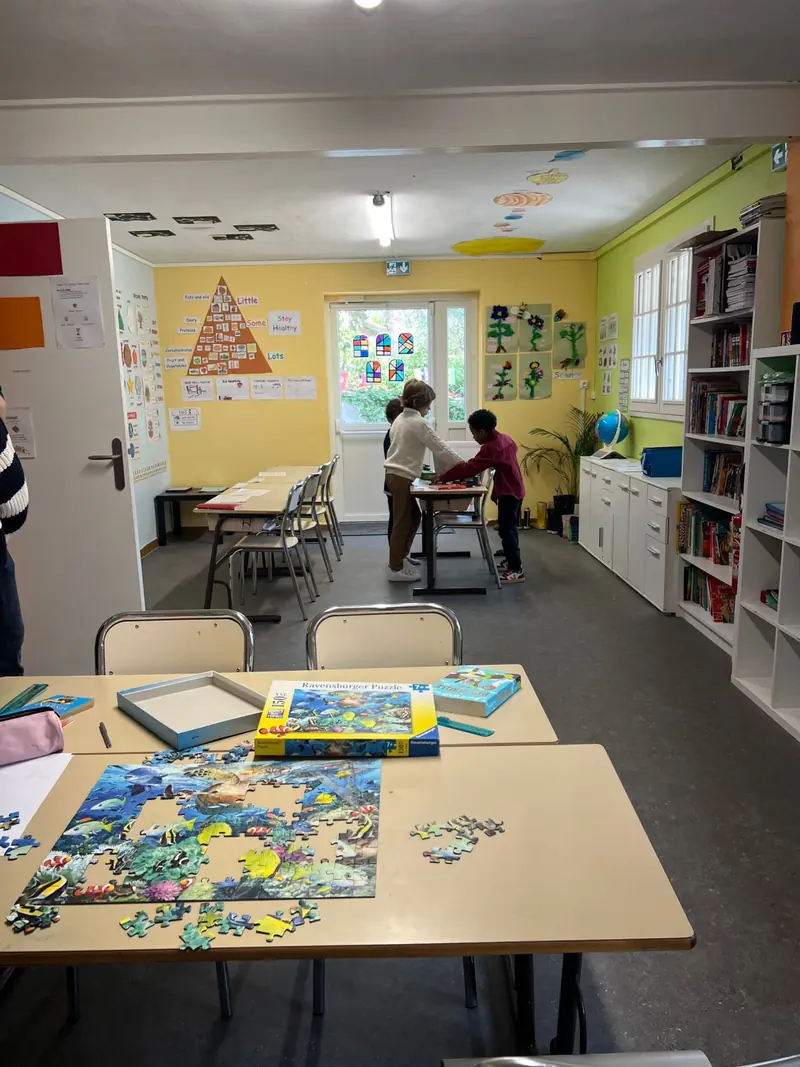
1. Children need to handle things
A child does not always understand better because an adult explains more. They may need to touch, move, compare, build, sort, measure, try, get it wrong and start again.
Hands-on work turns an abstract idea into a concrete experience. This matters especially with young children: before asking them to grasp certain ideas on paper, it can be very worthwhile to let them experience them first.
2. Workshops give the child an active role
A workshop is valuable because it makes the child a participant. They do not just watch someone do something: they do it. They sometimes choose, handle materials, observe the result, correct and try again.
This is exactly what we mean by active learning.
But be careful: a workshop is not automatically good teaching. Everything depends on what it actually lets the child learn. A workshop can be extremely rich; it can also be an activity that simply keeps children busy. The difference lies in the teaching intention, the teacher’s support and what the child is really building.
3. Independence is a skill, not a slogan
This is another important point of agreement. We want children to be able, gradually, to:
- get their materials ready;
- make a choice;
- start an activity;
- try before asking for help;
- identify a difficulty;
- look for a solution;
- explain what they have not understood;
- finish a piece of work;
- take on more responsibility over time.
But there is a fundamental difference between leaving a child free and teaching a child to become independent.
Independence is not about saying: “Do whatever you like.” It is about gradually giving the child the abilities they need to do more by themselves. It is supported independence.
4. Observing the child rather than just following a programme
Montessori gives observation an important place. We share that view.
A teacher should not only ask: “What do I need to teach today?” They should also ask: “Where is this child today?”
Have they understood? Do they need another explanation? Are they going too fast? Are they struggling? Do they need more practice? Can they go further?
Observation then becomes a tool for adjusting the teaching. And this is exactly where small classes make sense.
5. Kindness, yes. Indulgence, no.
This is probably one of the most important differences to explain.
We want an environment in which the child feels respected. They must be able to ask questions, make mistakes, try, start again, say they are struggling and ask for help.
But that does not mean the adult should shield them from all frustration or all demands. A child can be respected while being supported with high expectations.
Kindness does not mean: “Everything is wonderful.” It means: “I respect you enough to help you progress, even when it takes effort.”
Why we are wary of “positive education” misunderstood
“Positive education” is an appealing term. But it can cover very different practices and, above all, be misunderstood — as an obligation to be positive all the time.
A child does not need an adult to keep telling them: “Well done!”, “You’re amazing!”, “You’re so clever!”
The most useful feedback can be far more precise:
“You changed strategy and it worked.”
“You tried three times before you found it.”
“You made a mistake here. What could you try now?”
The distinction matters. Research on feedback shows that praise aimed at supposedly fixed qualities (“you’re clever”) does not have the same effects as praise aimed at the process, the strategies or the effort. The work of psychologist Carol Dweck and others links the latter to greater persistence when things get hard.
So kindness does not need to become flattery. It can take the form of respectful high expectations — which is also how self-confidence is built.
Children have the right to fail
This follows directly from our philosophy. If every mistake becomes a problem, a child quickly learns to avoid risk. They only answer when they are sure. They pick the easy exercises. They seek the adult’s approval. They may end up confusing succeeding with learning.
We prefer a different logic. The child must be able to try, fail, understand why, change strategy, start again, succeed — and then go further. That is what problem-solving is about.
A mistake then becomes information. Not a definition of the child.
So what exactly is Da Vinci Private School’s approach?
If we had to name it simply, we would call it individualised active learning. It describes our approach better than “Montessori”.
- Active, because the child does not just listen. They handle, search, experiment, question, discuss, produce and solve problems.
- Individualised, because the teacher seeks to take account of each child’s level, pace, needs and progress.
- Structured, because the child is not simply left free. Learning has objectives, teachers teach explicitly, skills are tracked, difficulties are identified.
- Demanding, because respecting a child does not mean lowering what we expect of them. On the contrary, the aim is to help them gradually develop their abilities.
Montessori and active learning are not opposites
It would be wrong to present things as “Montessori is good, our approach is better”. That is not our point.
Montessori is a coherent approach with its own principles, and it has been widely researched. A systematic review published in 2023 in Campbell Systematic Reviews kept 32 studies that met demanding methodological criteria. It found positive effects of Montessori on several academic and non-academic outcomes — including language, mathematics and executive functions — while noting how varied the Montessori practices studied were.
So it would be absurd to claim that Montessori “doesn’t work”. The question is a different one: is it exactly the approach we want to offer our children? Our answer is no.
What we borrow from Montessori
| What we value | Why |
|---|---|
| Hands-on learning | Understanding through experience |
| Workshops | Making the child active |
| Independence | Building the ability to do things alone |
| A suitable environment | Making learning easier |
| Observation | Understanding the child’s needs |
| Respect for the child | Building a healthy teaching relationship |
| Individual progress | Following the child’s real pace |
But these elements are not enough to make our school a Montessori school.
What sets us apart
Our approach also gives an important place to elements that do not necessarily belong to the classic Montessori model:
- explicit teaching;
- whole-group discussion;
- projects;
- collaborative work;
- individual tracking of progress;
- problem-solving;
- developing critical thinking;
- learning to read and write;
- teaching split equally between French and English;
- adapting activities to the needs of each group and each child.
A child may therefore work alone for a while, then discuss with a group, take part in a teacher-led activity, experiment, then receive an explicit explanation from the teacher.
We do not try to fit every learning situation into a single model. We look for the right way of learning at the right time.
The teacher remains essential
Active learning does not mean the teacher becomes secondary. Quite the opposite.
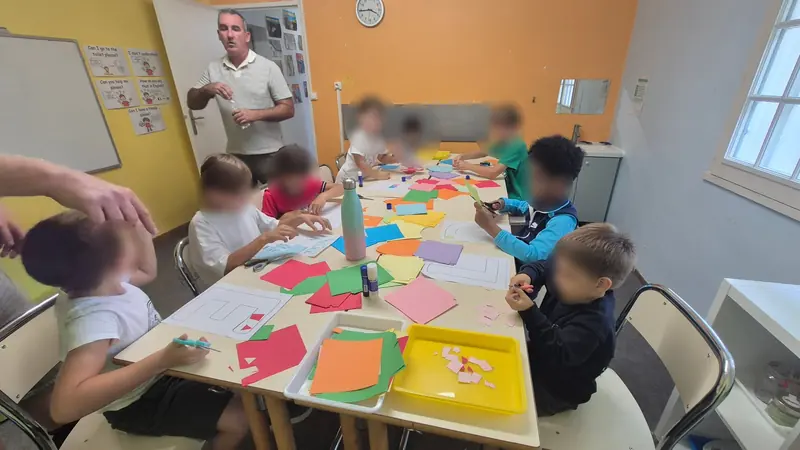
The more active the child, the more the teacher must be able to observe, choose the right level of difficulty, ask the right questions, explain at the right moment and step in when a child is stuck.
The teacher is no longer only the person who passes on content. They are also an observer, guide, expert, questioner and regulator of learning.
The aim is not to take the adult out of the process. It is to make their intervention more relevant.
Why not simply choose Montessori?
Because a teaching approach must fit the school’s overall educational project.
Truly adopting Montessori means being able to answer very concrete questions precisely: which materials? What organisation? What teacher training? How much room for the child’s choice? Which groups? What progression? What idea of independence?
We prefer to be transparent: Da Vinci Private School is not a Montessori school. We share some of Montessori’s insights because we find them relevant, and we build them into a broader approach, serving an international teaching programme that includes the requirements of the French national curriculum.
A teaching approach is not a collection of recipes
This may be the key point. One could take Montessori’s workshops, projects from active learning, kindness, neuroscience, learning through play, explicit teaching… and try to put it all together.
But a school does not get better by piling up methods. What matters is how coherent the whole is.
Why do children work in workshops? Why do we let them choose? Why step in now rather than five minutes earlier? Why ask more of this child and less of that one? Why a hands-on activity here, an explicit explanation there?
Every practice needs a reason.
What we want to build
We do not want children who follow a method perfectly. We want children who can search, understand, think, try, get it wrong, start again, learn and act for themselves.
That is why we borrow some ideas from Montessori. That is why we rely on active learning. That is why we insist on individualisation. And that is also why we are wary of a “positive education” that would turn school into a place where children must constantly be reassured or praised.
Children do not need constant praise. They need to be respected, supported, challenged and taken seriously.
Montessori, active learning: so what is the difference?
- Montessori is a complete method, built around a particular view of child development and a specific learning environment.
- Active learning is a family of approaches that put the child in a position of activity, enquiry, experimentation and building their own learning.
- Da Vinci Private School belongs to this second family, with strong individualisation and close attention to independence, hands-on work, projects, reasoning and bilingual development.
We may use some practices that also exist in Montessori. But we are not Montessori, and we are not trying to be.
We are trying to build the learning environment most consistent with our view of the child: active in their learning, supported by skilled adults, respected as an individual and challenged enough to go as far as possible.
Discover our bilingual pre-school and our bilingual primary school, or read the short answer in our frequently asked questions.
Ready to discover the Cocon d'Évolution?
The micro-campus welcomes 45 children in total. Take the time to talk with us and see whether the school is right for your child.
Apply for Admission