


Understanding our approach
Critical thinking in children: how to learn to think for yourself
9 June 2026
“Because the teacher said so.”
That sentence may seem perfectly normal. But at school, a much more interesting question can sometimes begin right after it: “Why?”
Why is it true? How do we know? Could there be another explanation? How could we check?
Developing critical thinking in children is not about learning to question everything. It is about gradually learning to think before accepting information, to tell what you know from what you assume, and to build your own reasoning.
And this skill begins long before a child meets social media, artificial intelligence or the conflicting information of the adult world. It begins with a simple question: “How do you know?”
Critical thinking is not learning to say no
There is a common confusion. A child who systematically contradicts adults is not necessarily developing critical thinking.
Saying “I don’t agree!” is not yet thinking.
Critical thinking requires something more demanding: being able to explain why you think what you think. A child can learn to say “I don’t agree because…”, and above all: “This is what makes me think so.”
So the goal is to teach children to examine an idea before adopting it, which is quite different from making them suspicious or contrary.
Children learn to think by asking questions
Young children ask a huge number of questions. Why is the sky blue? Why does this plant grow here? Why do we have to do it this way? Why can he and not me? Why didn’t this experiment work? Why do two people tell the same story differently?
These questions can sometimes tire adults. Yet they are extraordinary raw material for learning. We devote an article to this: A child’s curiosity: why it is essential for learning.
School can simply give the child the means to go further. Instead of answering straight away “Because…”, we can sometimes ask: “What do you think?” Then: “What makes you think that?” And finally: “How could we check?”
The child then receives not just information. They learn a way of looking for the truth.
Learning to tell a fact, an opinion and a hypothesis apart
This is a particularly important skill. Take a very simple sentence: “This plant grows better in the sun.”
The child can learn to ask:
- Is it a fact we have observed?
- Is it a hypothesis?
- Is it something someone told us?
- How could we check?
At their own level, the child begins to understand that a claim and a proof are not the same thing.
That obviously does not mean giving them an abstract philosophy lesson. It can start with a science experiment, a story, a discussion, a maths problem or even something noticed in the playground.
What if two children disagree?
That is exactly what makes it interesting.
In some situations, the school’s aim should not be to make the disagreement disappear straight away. Two children may have two different hypotheses.
Instead of immediately asking “Who’s right?”, we can ask: “How could we find out?”
The discussion changes completely. It is no longer about convincing the other at all costs. It is about looking for evidence to understand the situation.
The child then gradually discovers that a good idea is not necessarily the one defended most confidently. An idea must be able to stand up to examination.
Getting it wrong is part of critical thinking too
This is probably one of the hardest parts.
To develop critical thinking, a child must be able to discover that their own idea may be wrong. That is not always pleasant. Especially when they are very sure of themselves.
But learning to say “I thought it was that, but I was wrong” is an extremely valuable skill. It takes enough confidence to accept changing one’s point of view.
A mistake then becomes something other than a punishment. It becomes information: something has just shown us that our reasoning needs revising.
And that applies to maths, science, reading, relationships with others… and later, to a great many situations in life.
Thinking for yourself does not mean thinking alone
This is an important distinction. Children also develop critical thinking by comparing their ideas with other people’s.
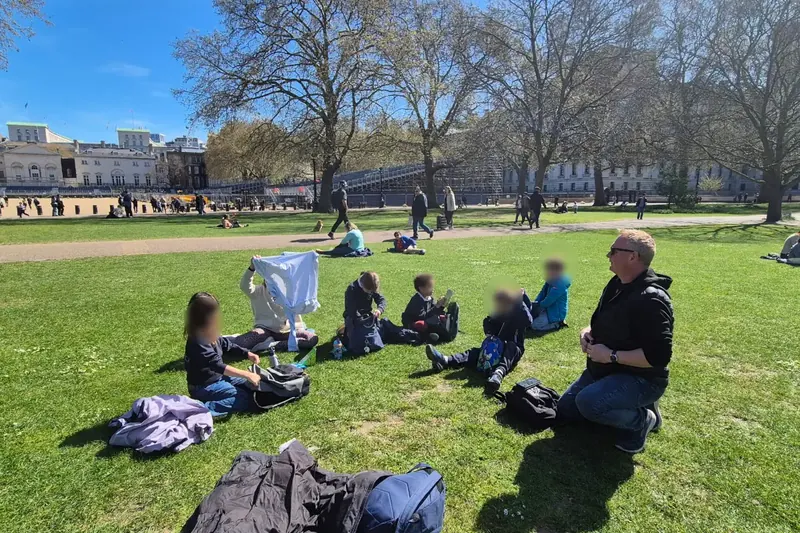
They listen. They explain. They discover another line of reasoning. They realise that someone can interpret a situation differently. Sometimes they have to change their own reasoning.
Group work can therefore be particularly rich when it is not just about sharing out tasks. A real discussion can force each child to make their reasoning clearer.
“Why do you think that?” “I hadn’t seen that possibility.” “You’re right about that, but…”
These are small phrases. But behind them, a real capacity for reasoning is being built.
Critical thinking is also built through hands-on activities
There is no need to wait until a child is old enough to analyse a newspaper article. A project can be enough. An experiment. A challenge. Something to build. A science question. A maths problem.
For example: “How can we make this structure hold more weight?”
The children suggest solutions. They test them. Some work. Others fail. They look at the results. They change their hypothesis. They try again.
Without even needing to say the words “critical thinking”, they are practising several of its core mechanisms: observe → question → form a hypothesis → test → analyse → adjust.
That is one of the strengths of active learning: thinking is no longer just something you talk about. It becomes something the child does.
And what about screens and artificial intelligence?
This skill is becoming particularly important.
Children are growing up in a world where they can access a gigantic amount of information in seconds. So the problem is no longer only “How do I find information?”. It is also: “How do I know whether I can trust it?”
And that question now also applies to answers produced by artificial intelligence.
An answer can be perfectly worded and still contain a mistake. A video can be convincing without being accurate. A claim can be repeated thousands of times without becoming true.
Children must learn that how easy information is to find says nothing about how reliable it is.
But here again, the answer is to teach them to ask good questions, rather than to distrust everything.
How can parents develop critical thinking at home?
There is no need to turn family dinner into a university seminar. A few habits can be enough.
- When your child states something with certainty, sometimes ask: “How do you know?”
- When they repeat something they’ve heard: “Who told you?”
- When they come across a contradiction: “What could explain the difference?”
- And when they get something wrong: “What made you think that?”
The last question is particularly interesting. It is not only about correcting the result. It tries to understand the path that led to the mistake.
It is precisely that path that allows the child to progress.
Can a school really teach a child to think?
Yes, but not simply by adding a subject called “critical thinking”.
The question goes much deeper. It is about how adults respond to children.
Are they allowed to ask questions? Can they suggest another hypothesis? Can they explain their reasoning? Can they make mistakes? Can they ask “why”? Can they change their mind when new information appears?
These everyday details often say more about a school’s real teaching than the words in its brochure.
Good questions to ask when visiting a school
If you want to understand how much room a school gives to reasoning, you might ask:
- “What do you do when a child gives an answer different from the one expected?”
- “Do children have to explain their reasoning?”
- “How much room do you give to discussion between children?”
- “How do you use mistakes?”
- “Do children work on problems that can have several solutions?”
- “What place do experiments and projects have?”
- “How do you teach children to check information?”
The answers are often very revealing. Because a school can say it wants to develop independence, creativity and critical thinking. But what really counts is what the child does every day.
The aim is not to produce children who doubt everything
This may be the most important point. Critical thinking does not mean believing everything is false. It means being able to say “I know”, but also:
- “I don’t know yet.”
- “I think that…”
- “I could be wrong.”
- “I’d like to check.”
- “I’ve just found something that changes my reasoning.”
This ability to change your mind when a better explanation comes along is not a weakness. It is a form of intellectual strength.
Learning to think before learning to convince
The world our children are growing up in will probably ask them to solve problems we cannot even foresee yet.
They will have to learn. Unlearn. Compare. Choose. Adapt. And sometimes admit they were wrong.
We cannot give them every answer in advance. But we can teach them something far more lasting: how to look for an answer.
So critical thinking in children does not begin with a grand lesson on disinformation. It begins much more simply. With an adult who, faced with a question, does not always answer immediately. And who sometimes asks: “What do you think?”
At Da Vinci Private School
At Da Vinci Private School, we want children not only to be able to repeat what they have learned, but also to understand, question, experiment and explain their reasoning.
Active learning, projects, small-group discussion and real-life situations create opportunities to practise these skills every day.
Because learning to think for yourself does not mean learning to think alone. It means learning to look at the world with enough curiosity to ask questions, and enough method to look for answers.
Discover how children learn at Da Vinci and our bilingual primary school.
Ready to discover the Cocon d'Évolution?
The micro-campus welcomes 45 children in total. Take the time to talk with us and see whether the school is right for your child.
Apply for Admission