


Helping your child build confidence
Why is my child bored at school?
28 July 2026
“He’s doing really well. But he says he’s bored.”
Parents say this a lot, and it raises a harder question than it seems: what does boredom at school actually mean?
A bored child isn’t necessarily doing too little work. Nor are they necessarily “too clever” for their class. Boredom has several possible causes, and before looking for a solution, it helps to work out which one fits your child.
Boredom at school has more than one cause
A child may be bored because:
- the activities are too easy for them;
- the pace of the class doesn’t suit them;
- they don’t really understand what is expected of them;
- they need more independence;
- they lack confidence, or don’t dare to take part;
- the activities do little to spark their curiosity;
- a specific difficulty is keeping them from getting into the learning.
The same behaviour can therefore cover very different situations. “My child is bored” is a starting point; the diagnosis is still to come.
A child can be bored even when they are doing well
It’s one of the most common paradoxes: good marks, exercises finished quickly, and less and less pleasure in going to school. When tasks no longer ask a child to search, try or get things wrong, school becomes predictable. The issue then has less to do with level than with challenge.
That case deserves an article of its own: why a child can be bored despite good grades.
But boredom can also hide a difficulty
The opposite mistake is to jump to conclusions. “He’s bored because he’s very bright” is an attractive explanation, sometimes true, often too quick.
A child may say they are bored because they don’t understand the activity, because they are afraid of getting it wrong, or because they don’t know where to start. Boredom then becomes a way of protecting themselves. Rather than “I can’t do this exercise”, they will say: “It’s stupid anyway.”
Behind that “it’s stupid” there is sometimes a child who doubts themselves and would rather not try. Hence the need to look at what is actually happening.
What to watch for in your child
A few questions can help you see more clearly.
When do they say they are bored? Every day, in certain subjects, or only with certain kinds of activity?
What do they do when they finish before the others? Do they look for something else to do on their own, or just wait?
How do they react when a task gets hard? Do they keep searching, ask for help, give up quickly?
Do they want to tell you what they are learning? Nobody is enthusiastic all the time. But curiosity that fades for weeks on end is worth paying attention to.
School doesn’t have to remove every difficulty
No school can promise that a child will never be bored there. There will be repetition, less exciting exercises, moments of waiting.
What you can expect is that the child is challenged enough to learn, and meets difficulties that match their level. Learning isn’t always easy, and that’s a good thing: many of the most formative experiences begin at the very moment a child has to search.
What can the school do?
It can start by watching how the child learns, then adjust:
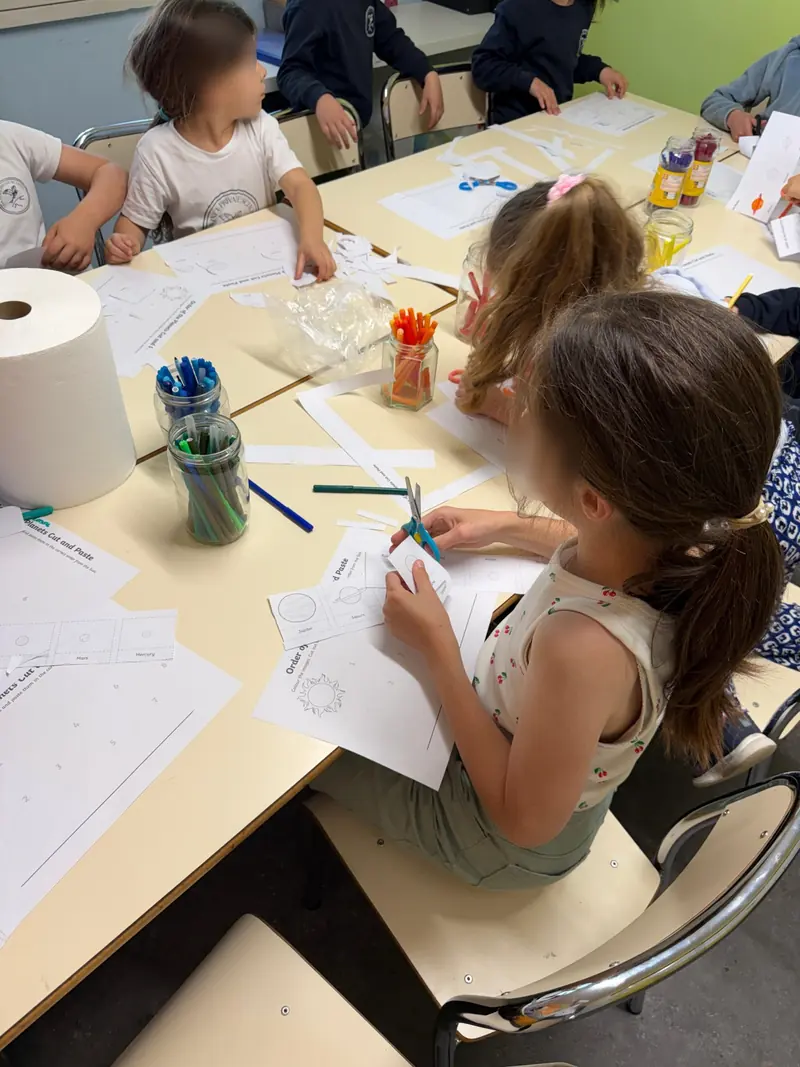
- the level of difficulty;
- the pace;
- the materials;
- the way of working, alone, in pairs or in a group;
- the degree of independence;
- the complexity of the problems set.
Adjusting doesn’t mean giving “more work”. Ten more exercises for a child who has grasped the principle is the same thing ten times over, and hardly individualised teaching. The better question is: which activity would help them progress right now?
Key points
A child who is bored at school deserves to be listened to, without being labelled straight away. Boredom can signal too little challenge, a difficulty, the wrong pace, a lack of confidence, a need for independence, or simply a passing phase.
Before thinking about changing schools, try to understand what is going on. Is your child really bored, or trying to tell you something else?
Ready to discover the Cocon d'Évolution?
The micro-campus welcomes 45 children in total. Take the time to talk with us and see whether the school is right for your child.
Apply for Admission