


Understanding our approach
Individualised active learning: our approach
18 August 2026
There are many words for talking about teaching: active learning, Montessori, positive education, personalised teaching, project-based learning, independence, differentiation…
Each term describes part of the reality. But at Da Vinci Private School, we were looking for an expression that brings together what we really want children to experience.
We chose: individualised active learning (in French, pédagogie active individualisée).
Because these words say something essential about how we see school.
- Active, because the child should not only receive.
- Individualised, because children do not all learn at the same pace or in the same way.
- Teaching, because behind the freedom to learn there must always be an adult who knows where they want to take the child.
Active learning: children don’t come just to listen
In purely transmissive teaching, things are simple: the teacher explains, the child listens, then repeats what they have learnt.
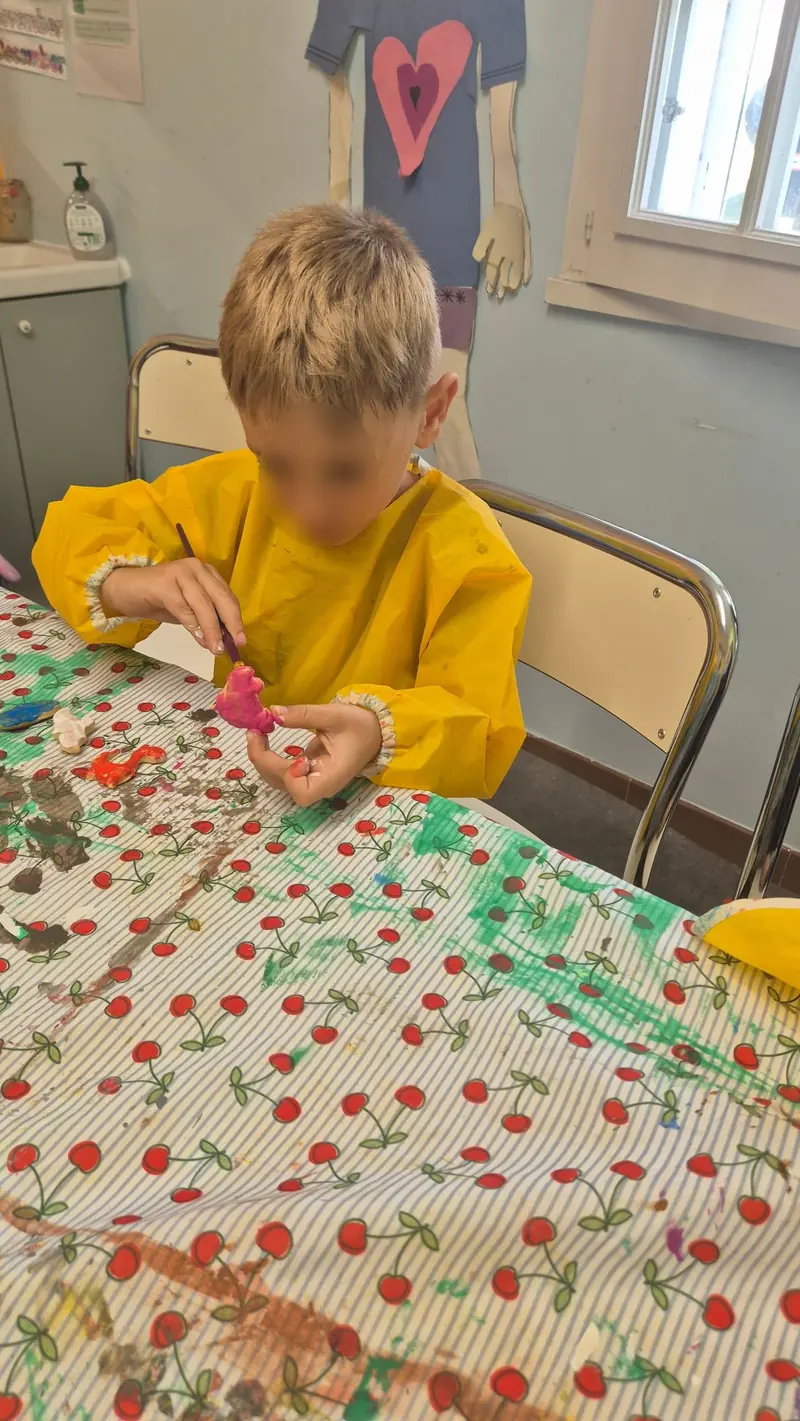
That approach can be useful in some situations. But learning is not only about storing information. A child also has to learn to search, try, handle, compare, question, explain, solve problems, make mistakes and start again.
That is the principle of active learning: the child genuinely drives part of their own learning. This can happen through a science experiment, a project, a problem to solve, hands-on work, research, a discussion, a piece of writing or a group activity.
What these have in common is not the format. It is the room given to the child’s own thinking.
Active does not mean “free to do whatever they like”
This is a common confusion. Active learning is not learning without structure.
A child who only chooses what they enjoy is not necessarily learning. Learning sometimes means doing something you would not have chosen. You also have to meet difficulty, persevere, accept not understanding straight away, start again, listen to someone else, learn a rule, memorise, practise.
So active learning does not do away with explicit teaching. It seeks to decide when the child needs an explanation, when they need to practise, when they need to search, and when they need to build an answer themselves.
The teacher remains indispensable. They observe, explain, question, structure, correct, encourage, adjust and help the child progress.
Why “individualised”?
Because a class is never a group of identical children. Two children can have the same age, the same teacher and the same programme and still have very different needs.
- One understands quickly but lacks confidence.
- Another works slowly but understands deeply.
- A third needs to handle things to understand.
- Another reasons very easily but needs help organising their work.
- One child may be very comfortable in maths and struggle with reading.
- Another may be very comfortable speaking and need particular support with writing.
Why ask them for exactly the same thing, at exactly the same moment, in exactly the same way?
Individualising does not mean a different programme for each child
Here too, a misunderstanding needs clearing up. A school cannot turn each class into fifteen completely different programmes.
Individualisation is more realistic — and more interesting — than that. It means keeping shared objectives while adapting, when needed:
- the level of difficulty;
- the pace;
- the explanations;
- the materials;
- the amount of practice;
- the level of support;
- the ways of taking part;
- the situations that let the child show what they can do.
The programme sets the framework. The path to it can vary.
Observe before stepping in
This is probably one of the biggest changes when a school really tries to individualise learning.
Teachers need to know the children in their class. Not just their results: they also need to watch how they work.
How do they react to a difficulty? Do they ask for help straight away? Do they give up too soon? Have they understood but don’t dare answer? Is it a misunderstanding or just a slip? Do they need another explanation? Have they already gone beyond the objective?
This observation avoids a classic mistake: confusing the result with the learning. That is the whole point of tracking progress beyond marks.
Difficulty is not the same for everyone
Picture two children facing the same problem. For one, the task is too easy: they finish quickly and wait. For the other, it is so hard they don’t know where to start.
Giving both exactly the same support may look fair. From a learning point of view, it is not necessarily equitable.
The aim is not to make everything easy. On the contrary: a child should regularly face a difficulty that demands real effort. But that difficulty has to be workable.
- Too easy, the child gets bored.
- Too hard, they get discouraged.
- Just hard enough, they learn.
Individualisation is largely about finding that space.
Demanding and kind
We do not believe in a school where children must constantly be reassured that everything they do is wonderful. It does a child no favours to make them believe they have succeeded when they have not yet.
But high expectations do not require harshness. You can say: “It’s not quite there yet. Let’s try again.” Without saying: “You can’t do it.”
That is the whole nuance: a mistake is about the work; it does not become a judgement on the person. So a child can be respected while being genuinely challenged — which is how self-confidence is built.
Kindness and high expectations are not opposites.
Independence comes step by step
We want children to learn to do things on their own. But doing things alone does not mean being left alone.
A child becomes independent because they have gradually learnt to:
- look for a solution;
- use the resources available;
- identify what they don’t understand;
- ask for help when it is needed;
- correct a mistake;
- organise their work;
- see a task through.
So the adult can help without doing things for the child, then gradually step back. It is supported independence.
Why small classes matter
This approach takes time and, above all, attention. In a small class, the teacher can more easily watch each child’s strategies, hear their questions, spot a difficulty or offer a challenge that fits.
That does not mean a small class automatically guarantees better teaching: a small class can perfectly well reproduce very traditional teaching. Class size is a lever, not a teaching approach. What counts is what the school does with it.
And bilingualism?
Our bilingual approach fits naturally into this logic. Learning in two languages is not about teaching the same lessons twice in translation. Children must use the language to understand, interact, search, explain and build their thinking — that is the difference between immersion and English lessons.
This calls for close attention to each child’s level of understanding and expression. Here again, the group objective can be shared, but individual needs differ.
So bilingualism is not an extra layer on top of the teaching: it is built into the learning.
Montessori, active learning, positive education: where do we stand?
Da Vinci Private School is not a Montessori school. We draw on some practices we find particularly relevant — hands-on work, workshops, independence, observing the child, a prepared environment — without claiming to reproduce the full Montessori method. We explain this in detail in Montessori or active learning: what is the difference?
Nor do we want “positive education” to be our identity. We prefer to talk about kindness with high expectations. Because a child needs:
- to be respected, but also to progress;
- encouragement, but also precise feedback on their work;
- confidence, but also difficulties to overcome;
- independence, but also an adult who knows when to step in.
It is exactly this combination that interests us.
Three words, one vision
In the end, the three words complete each other.
- Active: the child learns by doing, searching, experimenting, explaining and solving.
- Individualised: the child is not reduced to their age, their average or their assumed level. The teacher seeks to understand where they are and how to help them progress.
- Teaching: the framework, knowledge, objectives, progression and the teacher’s role remain essential.
So it is neither “let children learn however they like” nor “everyone moves at exactly the same pace”. It is a third way: a shared framework, ambitious goals, adapted learning paths.
What if the goal were not just to succeed at school?
This may be the question behind our whole approach.
Of course we want children to learn to read, write, count, reason, communicate and acquire the knowledge they need for their schooling.
But we also want them to know what to do when they don’t know. To be able to search, ask a question, try another method, change their hypothesis, ask for help, make a mistake without falling apart, start again — in short, to search rather than just find. And take charge of a growing share of their own learning.
Because the world they grow up in will not simply ask them to repeat what they were taught. It will ask them to understand, adapt, solve problems, cooperate, keep learning and think for themselves.
That is why we love these words so much: individualised active learning. They sum up our ambition better than a label.
Helping every child learn. Helping every child progress. And helping every child grow.
Discover our teaching programme, our bilingual pre-school and our bilingual primary school.
Ready to discover the Cocon d'Évolution?
The micro-campus welcomes 45 children in total. Take the time to talk with us and see whether the school is right for your child.
Apply for Admission