


Helping your child build confidence
Mistakes at school: a step, not a punishment
12 May 2026
A child raises their hand. They answer. And they get it wrong.
Sometimes a few seconds are enough for everything to change. A glance around. An awkward smile. A slight hesitation. Then this sentence:
“I knew I’d get it wrong.”
From that moment, the child may start learning something very different from what the teacher wanted to teach. They may learn:
- that it is better not to answer;
- that it is better to wait for someone else to find it;
- that questions you are not sure about should be avoided;
- that a mistake says something about their worth.
And gradually, school can become a place where the main goal is not to get things wrong.
We think the problem should be approached the other way round: mistakes are not the opposite of learning. They are part of it.
Getting it wrong means meeting what you haven’t mastered yet
When a child learns, they gradually build knowledge, methods and strategies. They try. They make a hypothesis. They act. They look at the result. Then they adjust.
Mistakes arise naturally in this process.
- A child learning to read may mix up two sounds.
- A child learning to write may forget a rule.
- A child learning maths may choose the wrong operation.
- A child solving a problem may set off in the wrong direction.
- A child learning a language may use a word that does not exist.
These are not necessarily signs of failure. They are information about where their learning stands right now.
A mistake tells us something. So the question becomes: what is it telling us?
A mistake is a warning light, not a breakdown
Picture a car’s dashboard. When a warning light comes on, nobody’s main goal should be to smash the light. You try to understand what it is signalling.
Mistakes play a similar role in learning. They can show:
- that an idea has not been understood;
- that a procedure is not yet mastered;
- that a strategy is not working;
- that an instruction was misread;
- or sometimes simply that the child was not paying attention.
So not all mistakes mean the same thing. And that is exactly what makes them interesting.
A mistake is not only: “Wrong.” It can become: “At what point did your reasoning change direction?”
That question is far richer.
A wrong answer can hold useful information
A child has to solve a maths problem. They give a wrong answer.
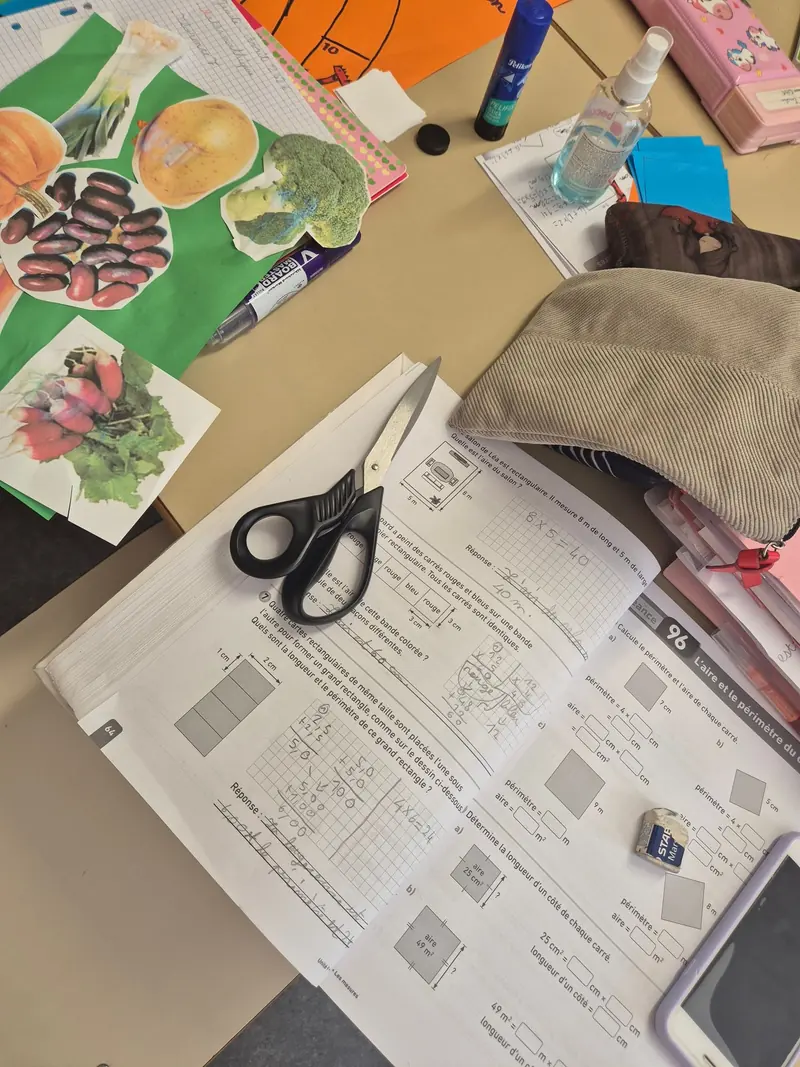
You can simply say: “No, that’s wrong.” Or you can try to understand how they got there.
Perhaps they didn’t understand the question. Perhaps they chose the wrong operation. Perhaps they know the method perfectly but made a calculation slip. Perhaps they used a strategy that would have worked in another situation.
The outcome is the same: the answer is incorrect. But the teaching information is completely different.
And that is where the teacher’s role becomes essential.
Mistakes make individualised learning possible
This matters especially in individualised active learning. If several children give a wrong answer, it is not necessarily useful to give them all exactly the same explanation.
- The first may need to revisit a basic idea.
- The second may have understood but needs more practice.
- The third may have used an interesting strategy that doesn’t suit this problem.
- The fourth may simply need more time.
Mistakes let the teacher look at the path, not just the destination. That is what makes it possible to adapt the support.
Getting it wrong without fear
This does not mean every mistake should be applauded. A mistake is still a mistake. A wrong answer needs correcting. A skill not yet mastered needs work. A rule not yet learnt needs revisiting.
The aim is certainly not to tell the child “It doesn’t matter if you get it wrong” and move on. The real message is different:
“You got it wrong. Good. Now let’s look at why.”
The mistake is neither dramatised nor ignored. It is used.
Turning “I’m useless” into “I don’t know yet”
There is a huge difference between these two sentences:
- “I’m bad at maths.”
- “I haven’t understood this idea yet.”
The first turns a difficulty at school into a judgement on oneself. The second describes a situation. And situations can change.
This matters especially for children who struggle repeatedly. After piling up wrong answers, some stop seeing mistakes as information and start seeing them as proof: proof that they are “not cut out for it”, that they are less intelligent, that they will never manage.
That is exactly the slide school must prevent. A difficulty in learning must not become an identity — which is what self-confidence at school is all about.
But mistakes must not become an excuse
There is another trap. By trying so hard to take the drama out of mistakes, we could end up no longer expecting progress. That is not our view.
- A child has the right to get things wrong, but must also learn to correct.
- They have the right not to know, but must gradually learn to search.
- They have the right to fail, but must discover how to try again differently.
A mistake is a step, not a destination, and everything else follows from that.
Learning sometimes means being bad at something for a while
We often wish children would understand straight away: read correctly from the first attempts, get their exercise right, pronounce a new word perfectly, find the right method at once.
But learning something new means precisely that you cannot do it perfectly yet. You have to accept that in-between phase: searching, hesitating, starting again, getting it right once and wrong the next time, understanding something on Tuesday only for it to seem gone by Thursday.
That phase can be frustrating, even uncomfortable. But it is normal.
You don’t become skilled by avoiding the phase where you aren’t yet.
Mistakes can build confidence
It may sound paradoxical: how could a mistake build self-confidence?
Precisely because a child who discovers they can survive a mistake starts taking more intellectual risks. They dare to try. They dare to answer. They dare to ask a question. They dare to put forward a hypothesis. They dare to say:
“I don’t understand.”
That last sentence may be one of the most important a child can learn to say. Because it opens the door to learning.
In a bilingual class, mistakes are even more natural
When a child learns a second language, mistakes become especially visible: a badly chosen word, approximate grammar, imperfect pronunciation, a sentence built on the rules of the other language — as also happens when a child mixes their two languages.
The child may be tempted to stay silent to avoid getting it wrong. Yet a language is not learnt just by listening: you have to use it, you have to speak. And to really speak, you have to accept not always speaking perfectly.
Language mistakes are therefore a normal part of the process. The aim is not to let them become fixed: the teacher uses them to help the child progress.
We correct without humiliating. We expect a lot without discouraging. We encourage without pretending everything is right.
Teachers are not only looking for the right answer
This may be one of the most important differences between correcting and teaching. Correcting can mean identifying what is right or wrong. Teaching also means understanding why.
Why did the child answer that? What had they understood? What had they assumed? What strategy did they use? At what point did their reasoning go off course?
And above all: how can they start again from that mistake to build a better understanding?
The teacher then becomes less a judge of the result than a guide through the process.
A school that accepts mistakes does not lower its expectations
On the contrary: it can expect more. Because it does not just ask “Did you get the right answer?”. It also asks:
- “Can you explain your reasoning?”
- “Why does this method work?”
- “What didn’t work?”
- “What could you try differently?”
- “What do you understand now that you didn’t before?”
Success then goes deeper than a good mark. The child learns to understand their own learning — which is what tracking progress beyond marks makes visible. And that ability will serve them well beyond school.
A mistake today, a skill tomorrow
A child who learns to analyse their mistakes develops something precious: the ability to adjust.
They meet a problem. They try. They fail. They observe. They change strategy. They try again. Then they succeed.
This sequence may seem ordinary. Yet it is one of the fundamental mechanisms of learning — the heart of problem-solving. And the older the child gets, the more it matters, because nobody can explain in advance how to solve every problem they will meet. They will have to learn to search.
At Da Vinci Private School, we look mistakes in the eye
We don’t want a school where children give the answer the adult expects just to avoid being wrong. We want them to be able to try, think, argue, test, get it wrong and start again.
That does not mean mistakes have no consequences. They must lead somewhere: a correction, a new attempt, an explanation, practice, a different strategy, or sometimes simply realising it is time to ask for help.
A mistake should move you forward. That is where it takes on its full meaning.
Children don’t need a school where they never get things wrong
They need a school where they learn what to do when they get things wrong. A school where:
- a wrong answer is not immediately turned into a judgement;
- a difficulty becomes information;
- you can say “I don’t know” without shame;
- you can start again;
- the teacher looks at the path as much as the result.
And above all, a school where the child understands something fundamental: getting it wrong does not mean you are incapable. Sometimes it simply means you are learning.
When a mistake becomes an indicator rather than a punishment, a child no longer just tries to avoid failure. They learn to use it.
Discover our teaching programme, our bilingual pre-school and our bilingual primary school.
Ready to discover the Cocon d'Évolution?
The micro-campus welcomes 45 children in total. Take the time to talk with us and see whether the school is right for your child.
Apply for Admission