


Helping your child build confidence
What role should parents play in their child's learning?
2 June 2026
“Have you done your homework?” “Have you learned your poem?” “Did you understand the maths?”
For many families, school ends up moving into the home in the form of reminders, homework, exercise books to check and lessons to recite.
And sometimes, without even realising it, parents almost become second teachers. They explain. They correct. They explain again. They check. They insist. Until everyone is exhausted.
So a question deserves to be asked: what is really the parents’ role in their child’s learning?
Should they step in more? Less? Make the child work every evening? Leave them completely alone?
As so often, the answer probably lies somewhere in between.
Parents are not meant to redo school at home
School and family do not have exactly the same role.
The teacher has a teaching responsibility: organising learning, observing progress, identifying difficulties, offering suitable activities and supporting the child’s development at school.
Parents can offer something different. An environment. Security. Curiosity. Conversation. Time. A relationship in which the child can talk about what they experience at school without immediately feeling they are being assessed.
That may seem less impressive than an extra maths session. But it is extremely important.
Children also learn outside homework
Learning does not necessarily mean sitting in front of a worksheet. A child learns when they:
- cook and measure quantities;
- read a story;
- build something;
- play a board game;
- ask a question;
- observe something happening;
- talk about their day;
- look for information;
- organise their things;
- discuss a problem they have met.
Everyday life is full of situations in which a child can develop their language, independence, reasoning or curiosity.
So parents don’t need to turn their home into a classroom. They can simply create an environment in which learning stays something natural.
“I don’t want them to fall behind”
This fear is understandable. When a child runs into difficulty, a parent’s reflex may be to compensate straight away.
They don’t read enough? Add more reading. They’re struggling with maths? More exercises. They’re not at ease in English? Add lessons.
Sometimes that really helps. But sometimes the child mainly builds up one feeling: “I’m never good enough.”
So the key is to understand what they really need. More practice? Another explanation? More time? A different kind of challenge? Teaching support? Or simply a break?
That is exactly why talking with the school matters.
Helping is not doing it for them
There is a huge difference between supporting a child and solving their problems for them.
A child says: “I don’t understand.” The parent can reply: “Look, do it like this.” Problem solved. But the child may not have learned to solve the problem.
Another option: “What have you understood so far?” Then: “Where are you stuck?” Then: “What could you try?”
The parent is still there. But they leave part of the thinking to the child.
This difference is essential for gradually developing their independence.
Children must also be allowed not to know
Parents naturally want to help their child. But there is one particularly useful phrase: “I don’t know.” It can be followed by: “Let’s find out together.”
The child then discovers two things. First, even adults don’t know all the answers. Second, not knowing doesn’t stop you from searching.
That lesson is far more important than it looks. Because all their life, the child will meet situations where they don’t immediately know what to do.
What if the child doesn’t want to work?
This is probably one of the great classics of family life.
The child sits down. Sighs. Looks elsewhere. Suddenly finds something extremely urgent to do. And the parent ends up saying: “Come on, concentrate!”
But before concluding that they lack willpower, several questions are worth asking:
- Is the task suited to their level?
- Is it too easy? Too hard?
- Is the child tired?
- Do they really understand what is being asked?
- Do they need a break?
- Do they simply need a little help getting started?
Visible behaviour does not always reveal the cause.
Motivation cannot always be ordered
Telling a child “Get motivated!” doesn’t usually produce much motivation.
The desire to learn can be fed by several things:
- understanding why you are doing something;
- having a suitable level of difficulty;
- seeing your own progress;
- being able to make choices;
- feeling capable;
- being allowed to try;
- being interested in the subject.
This is one reason why teaching and the school environment matter so much. A child can be very curious in some contexts and completely passive in others.
Parents can feed curiosity without giving a lesson
A child says: “Today we talked about volcanoes.”
The parent can simply ask: “What surprised you most?” Then: “Do you think a volcano can really go cold?”
And the conversation can head off in a completely unexpected direction.
There is no need to get out a textbook. The conversation itself can become a space for learning. And sometimes the child will take the subject much further on their own. See also: A child’s curiosity: why it is essential for learning.
Reading is probably one of the best examples
Reading with your child is not only useful for developing reading. It is also about:
- discussing the characters;
- imagining what will happen next;
- explaining a word;
- comparing two stories;
- giving an opinion;
- connecting it with what they know.
And once the child can read alone, the parent can gradually move from reader to reading companion.
Getting them to read more matters less than keeping the pleasure of understanding a story.
And screens?
The subject can quickly turn into conflict. But reducing the discussion to “Are screens good or bad?” doesn’t help much.
It is often more useful to ask: what is the child actually doing with the screen? Watching passively? Creating something? Looking for information? Talking to someone? Playing? Learning? For how long? In what context?
The aim is not necessarily to ban all screens. It may be to build a sensible relationship with digital tools.
And above all, to teach the child not to confuse available information with reliable information. That is what critical thinking is about.
Parents don’t need to know the curriculum by heart
Some parents feel guilty because they don’t know how to help. They no longer understand the maths methods being used. They don’t speak enough English. They’ve forgotten some grammar rules. They feel unable to support their child properly.
But it is not their job to replace the teacher.
A parent can ask: “Explain to me what you’re learning.”
That simple sentence can be very rich. Because the child has to put it into their own words. And explaining something to someone else is already a way of checking whether you have really understood it.
The relationship between parents and school matters enormously
School should not be a closed world whose content parents only discover when a problem arises.
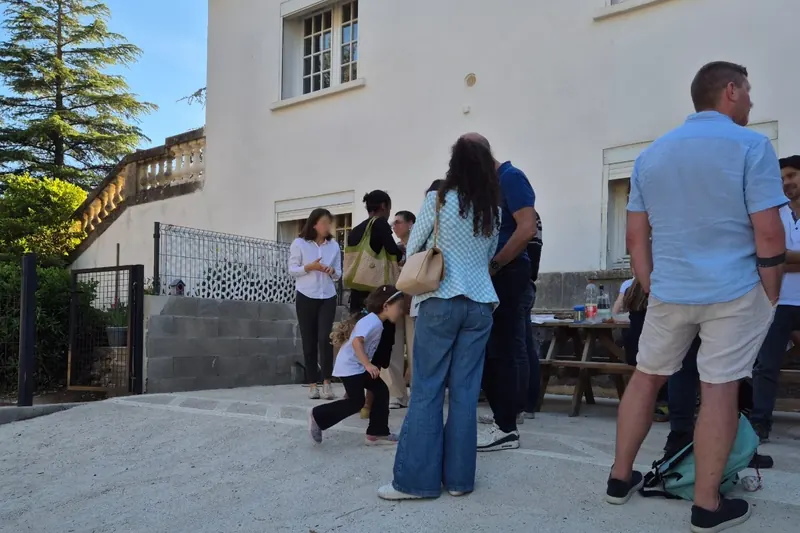
Conversely, a school cannot ask parents to become extra teachers.
The most useful relationship is probably one of cooperation. The school can explain: “This is what we are seeing.” Parents can add: “This is what we notice at home.” And together they can look for: “What would help this child now?”
This continuity can be particularly valuable when a child is struggling.
But parents also need to give the child their own space
This is probably the hardest part.
We want our child to succeed so much. We want to spare them pain. We want to spare them the mistakes we made ourselves.
So we step in. We remind. We check. We correct. We anticipate. We organise. Sometimes to the point of taking up so much room that the child has few chances left to take charge of their own schooling.
Helping your child sometimes means stepping back. Letting them search. Letting them get it wrong. Letting them handle a small responsibility. Letting them discover the natural consequences of some decisions.
Then being there when they really need us.
How can you find the right balance?
There is, of course, no universal amount of parental involvement. But a few questions can help:
- Is my help making my child more independent?
- Or: do they need me more and more for things they could do alone?
The first situation supports learning. The second may need adjusting.
A child never stops needing their parents; they come to need them differently.
Good questions to ask the school
Before choosing a school, it can be worth asking:
- “What role do you expect parents to play in learning?”
- “How do you communicate progress and difficulties?”
- “What do you advise parents when a child is struggling?”
- “How much work is expected at home?”
- “How do you develop children’s independence?”
- “How do you stop homework from becoming a source of family conflict?”
- “How can parents let you know about a difficulty they notice at home?”
These questions help you understand something important: what relationship does this school envisage between the child, their parents and their teachers?
The best support may not be the one that does the most
A child does not necessarily need a parent who watches over every line of homework.
They need an adult who believes they can learn. Who takes their questions seriously. Who accepts that they will make mistakes. Who knows when to step in. And who also knows when to step back because the child can try alone.
The school, for its part, must bring its teaching expertise and know the child well enough to explain to parents what is really happening in their learning.
When these two worlds work together without merging, the child can find their place.
And perhaps that is the real aim. Not to turn our children into perfectly controlled pupils. But to help them become increasingly independent learners.
At Da Vinci Private School
At Da Vinci Private School, we see parents as partners in their child’s schooling, without asking them to become their child’s teachers.
The school supports learning and follows each child’s progress. The family, for its part, provides an environment in which curiosity, reading, conversation and independence can carry on outside school.
The aim is to create continuity between the two worlds, while leaving each its own role.
Because a child needs support. But they also need, gradually, to be able to say: “I’m going to try on my own.”
Discover our bilingual pre-school and our bilingual primary school.
Ready to discover the Cocon d'Évolution?
The micro-campus welcomes 45 children in total. Take the time to talk with us and see whether the school is right for your child.
Apply for Admission