


Understanding our approach
Problem-solving at school: teaching children to search, not just to find
23 June 2026
A child can have good marks, know their times tables and be able to apply a method… while being completely at a loss when faced with a problem they have never met before.
And that is often where something important is at stake.
Problem-solving at school is not only about finding the right answer. It is about learning to search, try, make mistakes, change approach and start again.
In other words: learning to think.
Knowing an answer is not the same as knowing how to solve a problem
Imagine two children in front of the same exercise.
The first immediately asks: “But which operation do I have to do?”
The second looks at the question, works out what they already know, tries something… and then perhaps asks for help.
Both may end up with the right answer. But they are not necessarily learning the same thing.
The first is mainly learning to recognise a situation and apply a known procedure. The second is beginning to develop a much broader skill: dealing with a new situation.
That is exactly what we are trying to develop when we talk about problem-solving.
A problem is not simply a difficult exercise
At school, the word “problem” is often used for a maths exercise. But problem-solving goes much further.
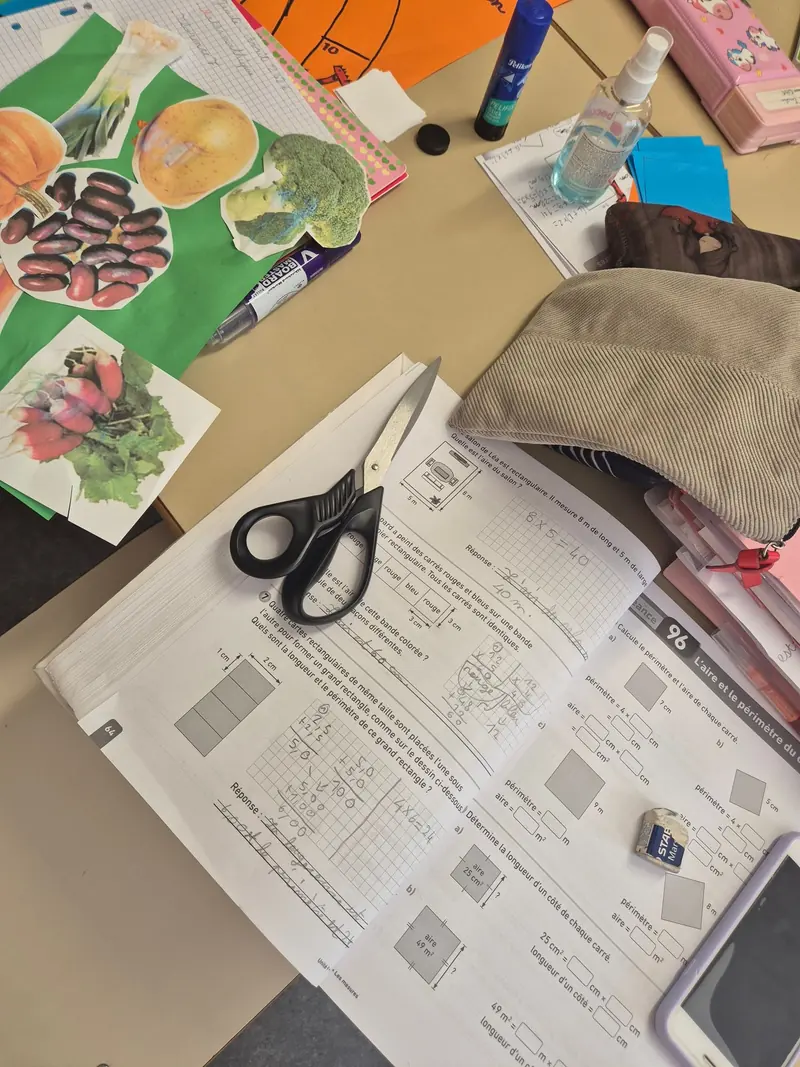
A problem arises as soon as a child:
- does not immediately know the answer;
- has to understand a situation;
- has to choose a strategy;
- has to choose between several possibilities;
- has to combine several pieces of knowledge;
- has to test a hypothesis;
- has to understand why a first attempt did not work.
It can be mathematical. But it can also be scientific, linguistic, practical, social or linked to a project.
Building a structure that doesn’t fall down. Understanding why an experiment isn’t working. Working out how to organise a group project. Looking for different ways to explain an idea. Deciding how to measure something.
Even a simple game can become a problem-solving situation.
What if the child gets it wrong?
This is probably one of the most important questions.
Because if every mistake is immediately corrected by the adult, the child sometimes learns something unintended: “As soon as I don’t know, someone will give me the answer.”
If, on the other hand, the mistake becomes information, it can help the child understand what didn’t work. They can then ask themselves:
- What had I imagined?
- Where did it go wrong?
- Why?
- What could I try differently?
- What does this mistake teach me?
The aim is obviously not to leave a child alone in front of a difficulty they cannot overcome. It is rather not to take away too quickly the thinking they are capable of doing themselves.
Helping a child does not mean giving them the solution
This is an essential distinction.
When a child is stuck, the adult may be tempted to say: “Look, you have to do it like this.” It is quick.
The problem is that the child may then have learned the solution… without learning how to find it.
Another approach is to ask a question: “What do you already know?” Then: “What are you trying to find?” Or: “What could you try?” And sometimes simply: “Try a first idea. We’ll see what happens next.”
Help then becomes temporary scaffolding. The adult supports the reasoning without replacing it.
Learning to search takes time
Problem-solving is sometimes at odds with a school logic focused on immediate efficiency. The curriculum has to be covered. Exercises have to be finished. Work has to be marked. It’s time to move on.
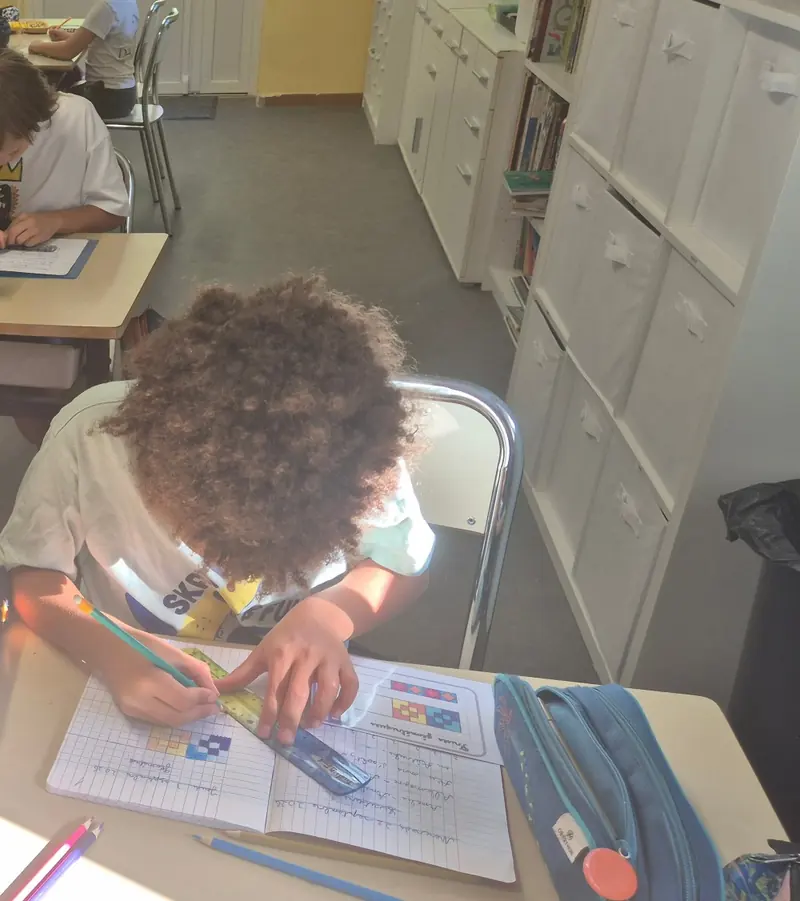
But some skills need a little slowness.
A child who is genuinely searching may take longer than a child who mechanically applies a method. They may try something that doesn’t work. Change their mind. Go back. Ask a question. Start again.
From the outside, this can look inefficient. Yet a large part of the learning is happening precisely during this search.
Not all children solve problems the same way
This is also why individualised teaching matters.
One child may need to handle things. Another will need to draw. A third will start by talking their reasoning through. Yet another will try something straight away.
There is not always just one way into a problem. So the teacher’s task is also to observe how each child thinks, where they get stuck and what kind of help can take them a little further.
This ties in directly with individualised teaching: the aim is not only to pass on an answer, but to understand where the child is in their reasoning and how to help them progress.
Small classes can make this work easier
Solving a problem requires being able to talk. Explaining your idea. Listening to someone else’s. Saying “I don’t understand”. Trying something. Making mistakes without fear of what others will think.
In a small group, the teacher can more easily notice these moments and step in in a targeted way.
But be careful: a small class does not automatically guarantee teaching based on problem-solving. What matters is what is actually done with the time available.
A small class can allow more discussion and individual support. The teaching still has to make real room for searching, experimenting and reasoning.
And in a bilingual setting?
Problem-solving takes on an interesting dimension in a bilingual environment.
When a child uses English to carry out an activity, they are not necessarily working on “their English” on one side and “their activity” on the other. They may need to use the language to:
- understand instructions;
- explain a hypothesis;
- ask for clarification;
- work with a classmate;
- present a solution;
- argue a point.
The language then becomes a tool for doing something. This is the logic of immersion: using a language to understand and act, rather than just learning lists of vocabulary.
How can you tell whether a school really develops this skill?
It is an excellent question to ask during a visit. Rather than simply asking “Do you practise active learning?”, try asking:
- “What happens when a child can’t find the answer?”
- “Do children have to look for several solutions?”
- “Are children allowed to try a method other than the expected one?”
- “How does the teacher step in when a child is stuck?”
- “How much room do you give to projects and real situations?”
- “How do you teach children to explain their reasoning?”
The answers to these questions often reveal the reality of a school far better than broad teaching labels.
The real goal: preparing children for problems nobody has taught them to solve yet
Nobody can teach a child the answer to every situation they will face.
They will inevitably meet new problems. At school. In their studies. At work. In their relationships. In daily life.
So rather than handing them every possible answer, the school gives them the means to face a question they cannot yet answer.
Search. Observe. Form a hypothesis. Try. Make mistakes. Understand. Start again.
It is this ability to move forward despite uncertainty that gradually turns a child who “can do their exercises” into a child able to think in a new situation.
Key points
Problem-solving at school is not only about succeeding at difficult exercises. It is about gradually developing the child’s ability to:
- understand a new situation;
- identify what they are looking for;
- choose a strategy;
- test an idea;
- accept mistakes;
- change their approach;
- explain their reasoning;
- ask for help without giving up;
- look for several solutions when possible.
And perhaps above all, to understand something fundamental: not knowing the answer straight away is often where learning begins, not a failure.
At Da Vinci Private School
At Da Vinci Private School, we give an important place to learning through experience, to reflection and to looking for solutions.
In a small school, teachers can do more than check whether a child knows the right answer: they can observe how the child thinks, learns and reacts to a difficulty.
Because school cannot prepare a child for every answer they will need in life. But it can help them become able to find their own.
Discover how children learn at Da Vinci and our bilingual primary school.
Ready to discover the Cocon d'Évolution?
The micro-campus welcomes 45 children in total. Take the time to talk with us and see whether the school is right for your child.
Apply for Admission