


Understanding our approach
Why can small classes change the way a child learns?
31 March 2026
“How many children will there be in the class?”
It is often one of the first questions parents ask when they visit a school. And that makes sense.
But the number of children does not tell the whole story.
A class of 15 children is not automatically better than a class of 25. It all depends on the teaching approach, the teacher, the organisation and the children’s needs.
On the other hand, the number of children can profoundly change how a teacher is able to support the class.
So what does a small class really change? Why do some families look for smaller classes? And above all, how can you tell whether this advantage is really present in a child’s daily life?
A small class is not just fewer children
You might think the difference between a class of 15 and a class of 25 is simply a matter of comfort.
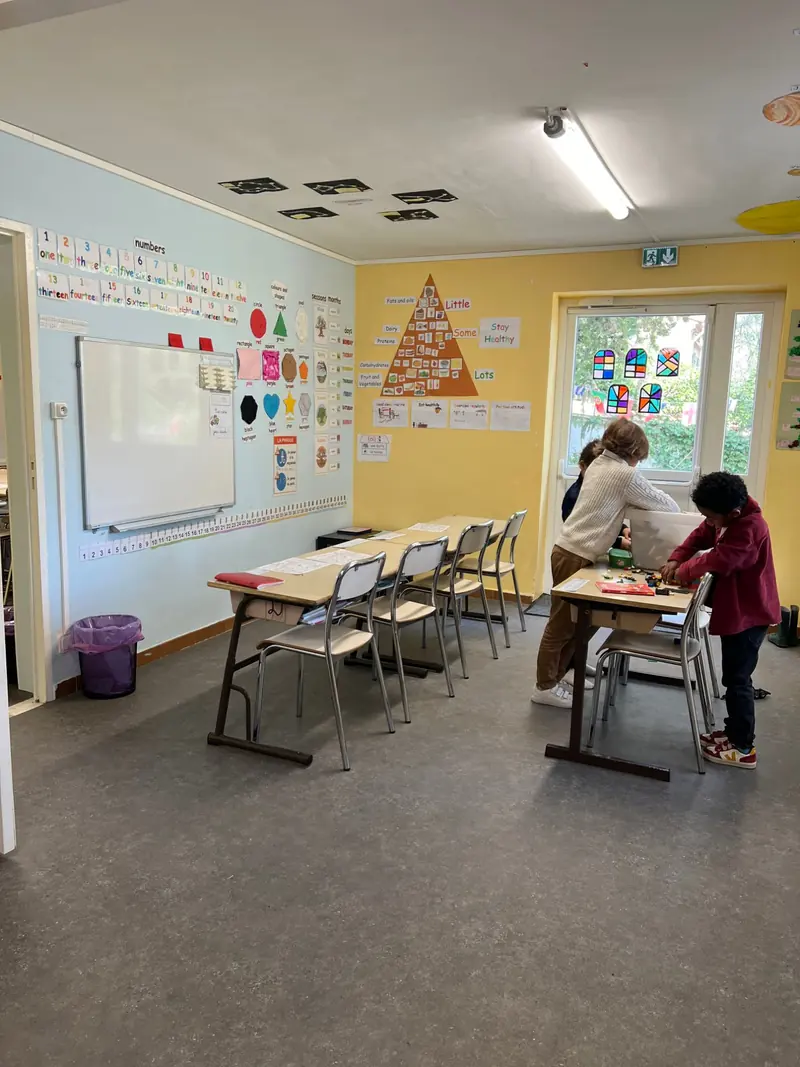
In reality, group size can affect many aspects of school life. In a smaller group, the teacher can potentially:
- observe each child more easily;
- give more speaking time;
- spot certain difficulties sooner;
- offer different explanations;
- follow progress more closely;
- organise certain activities more easily;
- get to know each child’s habits and needs better.
But note the key word: potentially.
A small class does not automatically guarantee better teaching. What matters is what the school does with that opportunity.
Why individual attention matters
Imagine a class in which a child does not understand an idea.
They don’t raise their hand. They don’t say they don’t understand. They just watch the others and try to keep up.
This kind of situation can go fairly unnoticed when the teacher is managing a large group at the same time.
In a smaller group, the teacher may have more chances to notice the child’s reactions. They can see:
- their hesitation;
- how they start an exercise;
- where they get stuck;
- the mistakes they repeat;
- the strategy they use.
This observation can make it possible to step in earlier. And sometimes, a few minutes of extra explanation are enough to unblock things.
Not all children learn at the same pace
A class rarely has a perfectly even learning pace.
One child may grasp an idea straight away. Another may need several examples. A third may understand the principle but struggle to apply it. A fourth may already have mastered the skill and need to go further.
The problem arises when the whole group has to move forward in exactly the same way, at the same moment.
Individualised teaching means taking these differences into account. That does not mean creating a completely different programme for each child. It can be much simpler:
- rephrasing an instruction;
- giving an extra example;
- changing the materials;
- setting a different exercise;
- allowing more time;
- offering an extra challenge;
- working in a small group for a while.
The smaller the group, the easier these adjustments can be to organise.
Does a small class really help you know the child better?
This is probably one of the most interesting aspects.
A child is not just a school level. They may be very confident speaking but hesitant in writing. Quick at maths but unsure of themselves when presenting their work. Very curious but easily distracted. Very independent in some activities and much more reliant on adults in others.
The better the teacher understands how the child works, the better they can adapt their support.
That takes time. And the time available per child depends, among other things, on the size of the group.
More chances to speak
Take a very simple situation. A teacher asks the class a question.
In a group of 25 children, obviously not everyone can answer every question. In a group of 12 or 15, it becomes easier to multiply the opportunities to take part.
This matters particularly in some activities:
- discussions;
- debates;
- project presentations;
- reading aloud;
- activities in English;
- solving problems together;
- presentations.
Taking part is not only a matter of confidence. It is also a way of learning.
Putting an answer into words forces the child to organise their thinking. Explaining their reasoning forces them to clarify what they have understood. Listening to others’ answers shows them other strategies.
And in a bilingual school?
The number of children can matter even more in a bilingual setting.
Learning a language is not just about hearing it. The child also needs opportunities to use it. They need to be able to answer, ask questions, interact, make mistakes and try again.
If 20 or 25 children all need to speak in a foreign language, each child’s speaking time can quickly become limited. In a smaller group, it can be easier to multiply interactions.
But here again, numbers are not everything. A school should also explain:
- how much room is given to speaking;
- how much time the child is exposed to each language;
- who teaches;
- how beginners are supported;
- how language progress is followed.
We look at these questions in detail in Bilingual immersion or English lessons: what difference for a child?
Small classes and active learning
Small classes can also make some forms of active learning easier.
In teaching based on experimentation, projects and problem-solving, children are not always sitting alone in front of their exercise books. They may:
- handle materials;
- build;
- discuss;
- experiment;
- work in groups;
- present their results;
- move around;
- test different solutions.
The larger the group, the more complex these activities can become to organise.
In a smaller group, the teacher can potentially spend more time observing and supporting. They can also see more clearly what each child is really doing during the activity.
This is particularly important. A project can look very successful as a whole while one or two children stayed on the sidelines. Truly individualised teaching must be able to spot this.
A small class must not become an excuse
Let us be very clear. A school should not be able to say:
“We have few children, so our teaching is necessarily personalised.”
That reasoning does not hold.
A class of 12 with highly standardised teaching can remain very little individualised. Conversely, an excellent teacher can do remarkable work in a larger class.
A small class is therefore a condition that can make certain practices easier, not a guarantee of quality.
The real question is: what does the school do with this extra capacity for support?
How to check whether a school really makes use of its small classes
This is probably the most useful question to ask during a visit.
Don’t just ask: “How many children do you have per class?”
Ask instead: “How do you use these small classes in your teaching?” Then ask for concrete examples.
How do you identify a child’s difficulties?
The school should be able to explain how it observes and follows children.
What happens when a child needs more time?
A precise answer is worth more than a general promise of “personalised support”.
What happens when a child has already mastered an idea?
Individualisation also concerns children who move ahead quickly.
How much time do children actually spend speaking?
Particularly important in a bilingual school.
Do children sometimes work in small groups?
This shows how the school uses its organisation.
How are parents kept informed of progress?
Follow-up should not be limited to the moments when a difficulty becomes serious.
A small class does not mean no group life
Another misconception to avoid. A small class should not become a place where each child is always working alone with the adult.
Interaction between children remains essential. Children also learn by:
- collaborating;
- explaining;
- negotiating;
- listening;
- helping;
- comparing points of view.
A small class can therefore look for a balance between individual support and group dynamics. That is probably one of the most interesting things to observe during a visit.
What is the right number of children per class?
There is no magic number.
Saying that a class of 15 is necessarily better than a class of 18, or that a class of 20 is necessarily too big, would be an oversimplification.
The right number depends, among other things, on:
- the children’s age;
- how the class is organised;
- the learning objectives;
- the number of adults present;
- the teachers’ training;
- the activities on offer;
- the degree of individualisation sought.
The number of children per adult is therefore often more telling than the number of children on its own.
Can a small class be more demanding for a child?
Yes. And it is a consequence worth remembering.
In a small group, it can be harder to stay invisible. The child is more often led to:
- take part;
- speak up;
- present their work;
- explain their choices;
- collaborate;
- receive feedback from the teacher.
This can be very stimulating. It can also take some children time to adjust.
A small group should therefore not be presented as an automatically more comfortable environment. The aim should rather be an environment in which the child can be both better supported and more engaged.
The real advantage: knowing the child
In the end, the question of small classes comes down to a fairly simple idea.
A teacher should not only know that a child scored 14 out of 20. They should gradually understand:
- what the child has mastered;
- what they have not yet mastered;
- how they reason;
- what motivates them;
- what holds them back;
- in which situations they progress;
- when they need help;
- when they can be more independent.
The smaller the group, the more feasible it can be to build this detailed knowledge of each child. But it takes a real commitment in the way teaching is designed.
The approach at Da Vinci Private School
At Da Vinci Private School, deliberately small classes are part of a wider approach to individual support.
Fewer children in a room is only the means. The purpose is to let teachers observe each child better, follow their progress and adapt their support when needed.
This organisation makes full sense when combined with active learning: children can experiment, work on projects, exchange ideas and solve problems, while the teacher can observe more closely how they learn.
In a bilingual setting, small classes also create more opportunities for interaction and for speaking.
How can you tell whether a small class is really an advantage?
When you visit a school, look less at the numbers and more at what really happens.
Watch the children. Do they speak up? Do they ask questions? Does the teacher know their names and their work? Do the children seem free to try, make mistakes and try again?
Ask how individual progress is followed. Ask what happens when a child runs into difficulty. Ask, too, what happens when a child is ahead.
The answers will tell you far more than the figure printed in a brochure.
Key points
A small class is not a guarantee of quality. But it can offer something precious: more opportunities for the teacher to see, listen to and support each child.
So the real question is not “How many children are in the class?”, but rather: “What does that number actually make possible in the way my child is supported?”
That is the difference to understand: a small class as a marketing argument, or a small class genuinely used as a teaching tool.
At Da Vinci Private School, small classes are designed as one part of a wider environment combining active learning, individual support and bilingual French-English education.
For families considering several schools, the best way to form an opinion remains very concrete: visit the school, observe a class and ask precise questions about the children’s daily life. Discover our bilingual pre-school and our bilingual primary school.
Ready to discover the Cocon d'Évolution?
The micro-campus welcomes 45 children in total. Take the time to talk with us and see whether the school is right for your child.
Apply for Admission