


Choosing a school for your child
State, private or international school: what difference for a child?
26 May 2026
When the time comes to choose a school, many parents start by comparing categories: state, private, bilingual, international…
But these words can give an impression of clarity while covering very different realities.
A private school is not necessarily an international school. An international school is not necessarily bilingual. A bilingual school is not necessarily independent.
And above all, two schools in the same category can offer completely different school experiences.
So how do you find your way? The most useful thing is to look at what lies behind the label.
State schools: a national framework and a public service
State schools (“école publique”) are part of the national education system. They take children according to catchment-area rules (“carte scolaire”) and follow the national curriculum.
For many families, they are the natural school setting for their child. They can also offer a wide variety of profiles, projects and experiences depending on the school and its team.
But avoid a common mistake: talking about “state school” as if it were a single teaching model.
Two state schools can have very different organisations, teams, projects and atmospheres. The status alone is not enough to understand what your child will really experience.
Private school: a status, not a teaching approach
The word “private” can also be misleading.
One private school may have a very traditional educational project. Another may be strongly focused on languages. Yet another may emphasise projects, the arts, sport or a particular teaching approach.
Private status alone does not tell you how the child learns. You need to look at the school’s project, and above all distinguish between two main situations: private under contract (“sous contrat”) and independent private (“hors contrat”).
Under contract or independent: what is the difference?
A private school under contract with the State remains tied to the national education framework and has a contract with the State. Its teachers are subject to specific conditions, and the school takes part in the public education service under the terms of that contract.
An independent private school has greater freedom in how it organises its teaching, although it remains subject to legal obligations and to State inspection.
This freedom can allow some schools to build a very distinctive educational project. But it does not automatically mean “better teaching” or “a better school”.
Above all, it means more freedom in certain teaching and organisational choices. And that freedom has to be judged through the school’s actual project.
And an international school?
The word “international” can be even harder to interpret.

A school can make substantial use of a foreign language without working exactly like an international school in the sense some families have in mind.
Depending on the school, the word may refer to:
- the language of instruction;
- an international curriculum;
- an international pupil population;
- preparation for certain qualifications;
- a strong cultural openness;
- or a combination of several of these.
So ask a simple question:
“When you say international, what does that concretely mean for my child each week?”
The answer will tell you far more than the word “international” itself.
Bilingual school: two languages, but above all two uses
The same problem arises with the word “bilingual”.
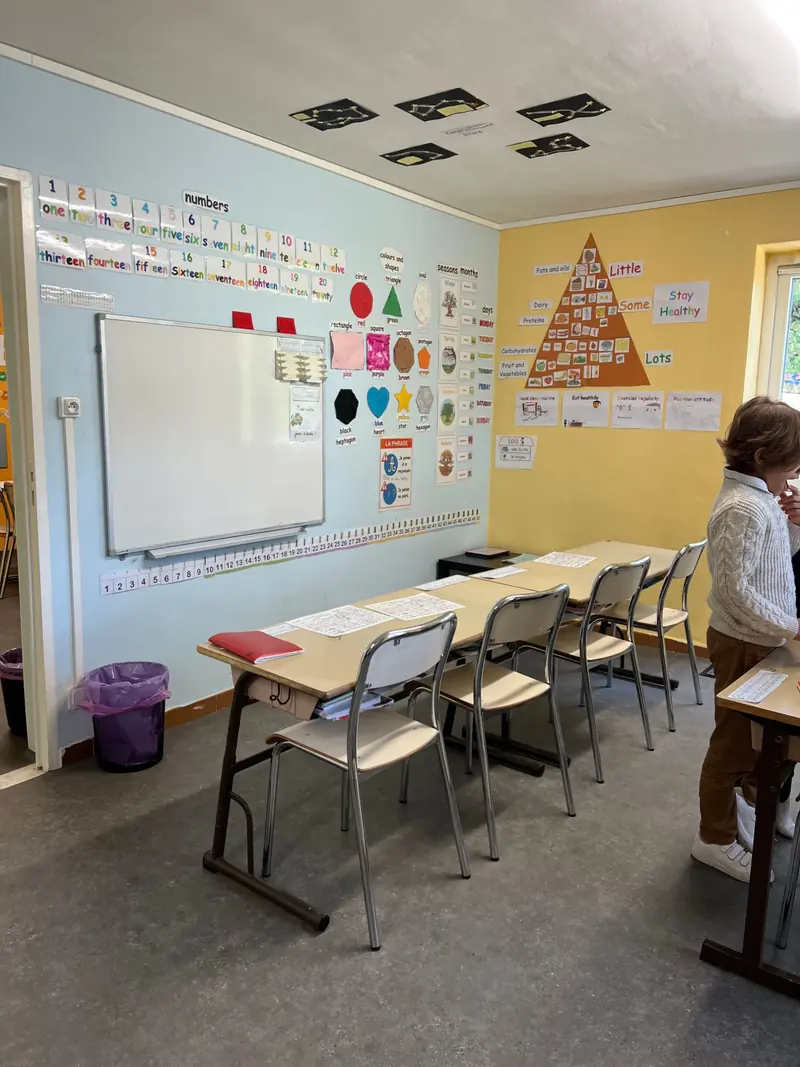
One school may offer a few hours of English a week. Another may use English every day in certain activities or subjects. The difference for the child can be considerable.
So the real question is not only: “How many hours of English are there?” But: “What does my child do in English?”
Do they listen? Speak? Play? Learn? Ask questions? Work with other children?
The more the language becomes a real tool for communication, the further the experience moves from a simple language lesson. We look at this difference in detail in Bilingual immersion or English lessons: what difference for a child?
A bilingual school is not necessarily an international school
This is a fairly common confusion.
A bilingual school can work mainly within the French educational framework while giving English an important place. An international school may have a different organisation, curricula and pupil population.
So look carefully at:
- the languages used;
- the curriculum followed;
- the teachers’ qualifications;
- how children are assessed;
- the qualifications prepared for;
- the place given to other cultures;
- the intended path for further study.
The word on the front of the building is not enough.
And where does Montessori fit in?
Same logic. “Montessori” describes a specific teaching approach. It is not simply an administrative category comparable to “state” or “private”.
A school can be private and Montessori. It can also offer another form of active learning without being Montessori. It can be bilingual without being Montessori. The different dimensions can combine.
This matters because parents sometimes look for a label when what they are really looking for is an environment suited to their child.
So what really changes for the child?
If you are comparing several schools, try to move gradually from the administrative level down to the concrete one.
Level 1: status
State? Private under contract? Independent private?
Level 2: the project
What vision of education? What place for the child? What teaching approach?
Level 3: organisation
How many children per group? How do the adults work with them? How is progress followed?
Level 4: languages
Which language is used? When? How often? For which activities?
Level 5: daily life
What does the child actually do during the day?
It is often at this last level that the differences become most interesting.
What to ask during a visit
Rather than only asking “Are you a private school?” or “Are you bilingual?”, try these questions:
- “How many children are in the class?”
- “What share of the day takes place in English?”
- “What do the children actually do in English?”
- “How do you adapt your support when a child moves faster or more slowly?”
- “How do you track progress?”
- “How do you develop independence?”
- “What happens when a child runs into difficulty?”
- “Can you give me a concrete example?”
A school that truly masters its project should be able to answer concretely. You will find more useful questions in How to choose a primary school: the 15 criteria that really matter.
The trap of oversimplified comparisons
Imagine three schools.
- School A: a large state school, fairly large classes, an experienced team, many projects.
- School B: a small private school, small groups, individual support, a distinctive educational project.
- School C: an international school, heavy use of English, a multicultural environment, a specific curriculum.
Which one to choose? There is no universal answer. It depends, among other things, on:
- the child;
- the family;
- the educational project you are looking for;
- languages;
- the child’s level of independence;
- future mobility;
- budget;
- geographical constraints;
- and the way the child learns.
That is precisely why a general league table of schools can be far less useful than a comparison based on your own criteria.
Price does not tell the whole story
Cost is obviously a real criterion for a family. But comparing fees alone can lead to misleading conclusions.
Look at what is included and, above all, at what the child actually receives in return:
- group size;
- teaching time;
- languages;
- activities;
- support;
- outings;
- materials;
- services offered;
- how the day is organised.
Two schools with different fees are not necessarily offering the same education. For our school: what the fees cover and what comes on top.
And most important of all: look at your child
This is probably the best filter. Picture your child in each environment. In which one could they:
- ask questions?
- speak up?
- make mistakes without fear?
- progress at their own pace?
- gradually become independent?
- develop their interests?
- build relationships?
- learn to work with others?
A school can be excellent for one child and far less suited to another. That is not a contradiction. It simply follows from the fact that children are not interchangeable.
Da Vinci Private School
Da Vinci Private School is an independent private school (“hors contrat”) whose project is built in particular around small groups, French-English bilingualism and active learning.
But these features should not be seen as sufficient arguments in themselves. The real question is always: does this environment suit your child and your family’s plans?
That is why choosing a school deserves a real meeting. A brochure can explain a project. A visit lets you begin to see how that project comes to life.
Discover our bilingual pre-school and our bilingual primary school.
So: state, private or international?
In the end, the right question is perhaps not: “Which type of school is best?” But: “Which educational environment best suits my child and our family?”
A school’s status gives you a first piece of information. Its educational project gives you a second. But it is the child’s daily reality that really lets you understand the school.
Before choosing, compare labels less. Compare the experiences the children will actually have.
Key points
| What you are comparing | What you really need to look at |
|---|---|
| State / private | Status and organisation |
| Under contract / independent | Teaching freedom and regulatory framework |
| Bilingual | Real use of both languages |
| International | Curriculum, languages and international environment |
| Small class | What the school does with the smaller size |
| Active learning | What the children actually do |
| Price | What is concretely offered in return |
A school is never just its status. Behind each category are schools, teams and projects that differ profoundly.
The right choice begins when you stop looking for the perfect label and start looking at the reality the child experiences.
Ready to discover the Cocon d'Évolution?
The micro-campus welcomes 45 children in total. Take the time to talk with us and see whether the school is right for your child.
Apply for Admission