


Choosing a school for your child
How to choose a primary school: the 15 criteria that really matter
14 April 2026
Choosing a primary school for your child is not simply choosing a school a few kilometres from home.
It is choosing an environment in which they will spend a considerable part of their childhood.
They will learn to read, write, reason and work with others there. But they will also build something much harder to measure: their relationship with learning.
Will they want to understand? Dare to ask a question? Accept making mistakes? Speak up? Gradually become independent? Or will they mostly learn to do what is expected of them?
There is, of course, no perfect school for every child. But there are criteria that let you look at a school beyond its website, its ranking or the colour of its walls.
Here are the 15 questions we suggest you ask yourself. If you are new to the French school system, start with our guide How to choose a school for your child in France, which explains the different types of school.
1. How does the school see the child?
This is probably the most important question.
Before looking at the activities on offer, the languages taught or the facilities, try to understand the view of the child behind the school’s educational project.
Is the child seen as a pupil to whom a curriculum must be delivered? Or as a person capable of searching, experimenting, questioning and making progress?
This difference may sound philosophical. It is not. It directly shapes how adults teach, correct, encourage and support children.
2. How many children are really in a class?
The number on paper does not tell the whole story. Ask:
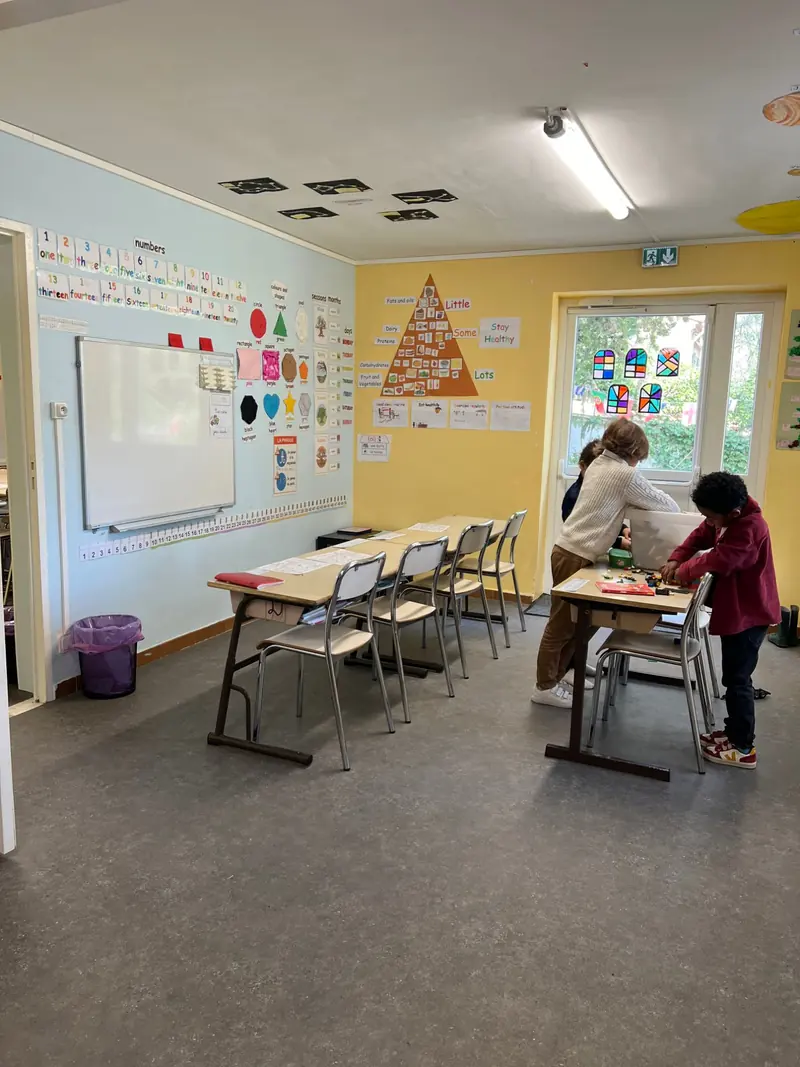
- how many children are actually present;
- how many adults work with the group;
- how small-group work is organised;
- how much room each child has in discussions;
- how the teacher supports a child who moves faster or more slowly.
A small class does not, on its own, guarantee a better education. But it can allow more interaction and closer observation of each child.
So the real question is: what does the school actually do with this smaller size? We devote an article to this: Why can small classes change the way a child learns?
3. How does the school handle different paces?
In a class, children never move forward at exactly the same pace.
One may read very early. Another may need more time. One child may be very comfortable with maths but lack confidence speaking. Another may understand very quickly but need help organising their work.
A serious school should be able to explain what it does about this diversity. Ask, for example:
- “What happens when a child has already mastered a skill the class is working on?”
- And conversely: “What do you do when a child hasn’t understood yet?”
The answers to these two questions are often far more revealing than general talk about “personalised support”.
4. How is progress tracked?
Marks are not the only way to measure a child’s progress. But having no marks does not mean assessment is unnecessary.
Ask:
- which skills are tracked;
- how teachers observe progress;
- how difficulties are identified;
- how parents are informed;
- how the child understands their own progress.
Good tracking is not about producing more paperwork. It should answer one simple question: where is this child today, and what is the next step for them?
5. How does the school treat mistakes?
This is a detail that isn’t one.
What happens when a child gives a wrong answer? Is it corrected immediately? Is it seen as a chance to understand? Does the child dare to try again?
Real learning always involves mistakes. An environment in which children are afraid of getting things wrong can gradually lead them to search less, take fewer risks and take part less.
A school can instead use mistakes as learning material. That obviously does not mean “anything goes”. It means a mistake can become a step in the reasoning.
6. Does the child only learn knowledge, or also how to use it?
Knowing a rule is one thing. Knowing how to use it in a new situation is another.
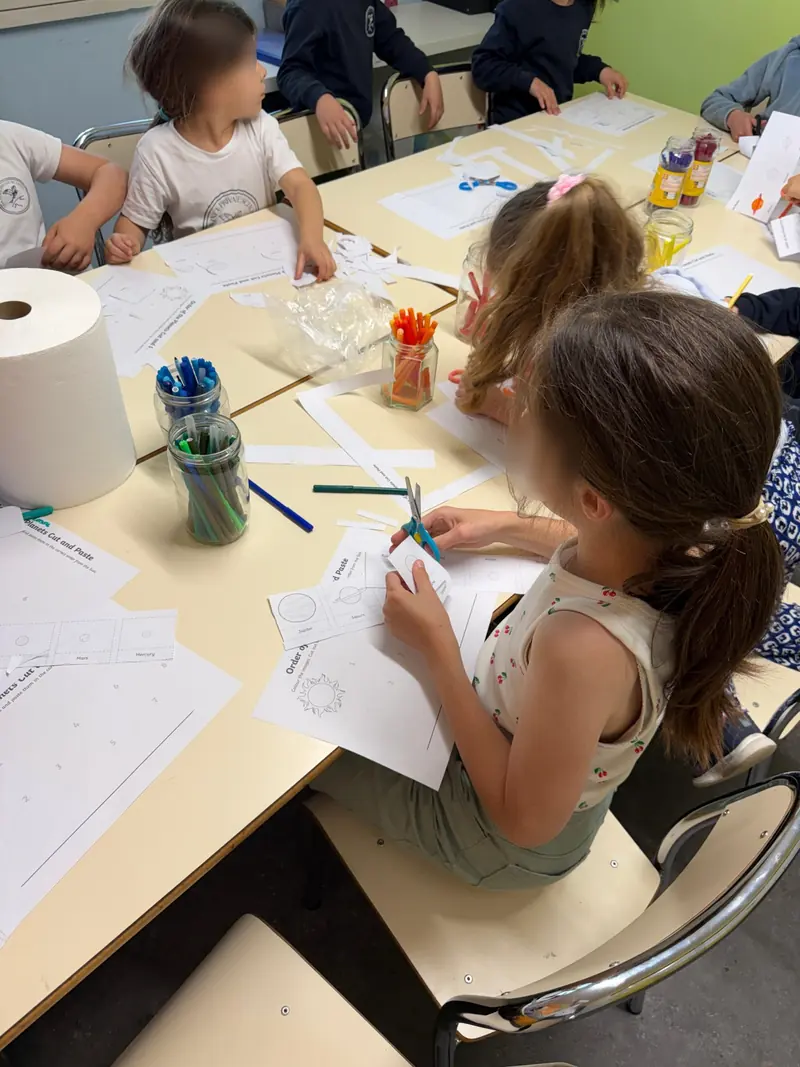
Ask to see real activities. Do the children:
- solve problems?
- explain their reasoning?
- handle materials?
- build?
- research?
- experiment?
- work together?
- present what they have understood?
This is where active learning can profoundly change the school experience. The child is no longer only the one who receives information. They gradually become the one who must do something with it.
7. How much room does the school give to curiosity?
Children ask a great many questions. Why? How? What if…? What would happen if we did it differently?
A school can see these questions as interruptions. It can also see them as opportunities to learn.
That does not mean every question must become a two-hour lesson. But a school that values curiosity generally tries to understand what lies behind children’s questions.
Ask: “What do you do when a child asks a question nobody can answer straight away?” The answer can be very telling.
8. How does the school develop independence?
“Your child will become independent” is an easy sentence to write in a brochure.
It is much more interesting to ask: what does a child do alone at this school that they could not do alone before? Can they:
- get their materials ready?
- organise a task?
- look for information?
- ask for help appropriately?
- check their work?
- explain what they have to do?
- manage their time?
Independence does not appear by itself. It is built. And to build it, children must be given real responsibilities.
9. How does the school teach languages?
If you are looking for a bilingual school, don’t just ask: “How many hours of English a week?” The information is useful, but not enough.
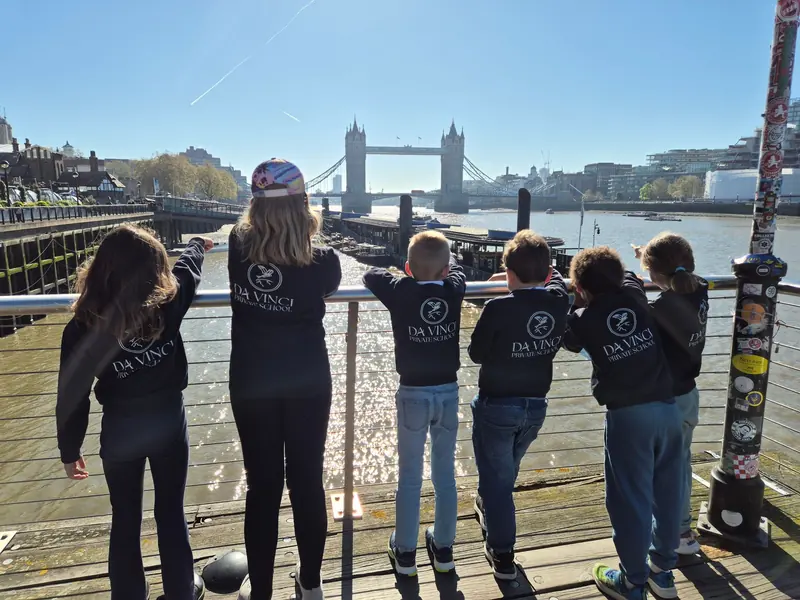
Ask instead:
- In which situations is English used?
- Who speaks it with the children?
- Do the children use it spontaneously?
- Are some subjects taught in English?
- How much room is given to speaking?
- How does the school support children at different levels?
A language does not become truly familiar just because it appears on a timetable. The child has to be able to use it. To go further: Bilingual immersion or English lessons: what difference for a child?
10. Do children really get the chance to speak?
This is particularly important in bilingual education.
A child can spend a lot of time listening to an adult speaking English without having many opportunities to speak themselves.
During a visit, watch the children. Do they speak? Ask questions? Talk to each other? Ask for help? Explain their ideas?
A school can look wonderful on paper. But what the children actually do is often far more revealing.
11. What is the relationship between teachers and children?
Watch the adults closely.
How do they speak to the children? Do they only call on them to correct them? Do they encourage them to explain? Do they know what interests them? Can they tell you precisely about their strengths and difficulties?
A good teaching relationship does not mean the adult becomes the child’s “friend”. They remain an adult, a teacher, someone who sets boundaries. But those boundaries can be demanding while being deeply respectful.
12. How does the school deal with difficulties?
This question is often forgotten during a visit. People talk a lot about what works. You should also ask:
- “What do you do when a child has a persistent difficulty?”
- “How are parents involved?”
A school does not need to claim that every child always succeeds. An honest answer about difficulties can be far more reassuring than a presentation in which everything seems perfect.
13. What relationship does the school have with parents?
Parents are not extra teachers. But they are part of the child’s educational environment. So it helps to understand:
- how information is shared;
- how often parents are kept informed;
- how meetings are arranged;
- how difficulties are flagged;
- what part parents can play in school life.
The right question is not “Does the school communicate a lot?”, but “Is the communication useful?”. Lots of messages do not necessarily mean lots of information.
14. What is the school’s real atmosphere?
You won’t find it in any brochure. During the visit, take a few minutes simply to observe.
How do the children move around? How do they talk to each other? Do the adults seem to know the children? Do the children look constantly under pressure? Or, on the contrary, left entirely to themselves?
The aim is not to find a school where children are happy every second. That does not exist. A school day includes effort, frustration, conflict, mistakes and moments of tiredness.
The question is rather what overall climate the school builds around all of that.
15. And above all: is this school really right for your child?
This is probably the most forgotten criterion. A school can be excellent on paper and still not suit your child.
Is your child more:
- very independent?
- very sensitive?
- extremely curious?
- reserved?
- very sociable?
- comfortable in a large group?
- at their best with close support?
- passionate about languages?
- particularly drawn to hands-on activities?
The perfect school does not exist; some schools simply suit a particular child better than others.
Questions to ask during a visit
If you only remember about ten questions, take these:
- How many children are really in each class?
- How do you support children who don’t all move at the same pace?
- How do you spot difficulties?
- How do you measure progress?
- How do you treat mistakes?
- How do you develop independence?
- How much room do children have to speak and explain their ideas?
- How are languages used day to day?
- How are parents kept informed?
- Can you give me a concrete example of a child you have supported in their progress?
The last question is particularly interesting. It forces the school to move beyond general statements.
Don’t choose a school from its website alone
A website can be beautiful. A brochure can be extremely convincing. A team can present an inspiring educational project.
But nothing replaces a visit.
Watch the children. Listen to the adults. Ask questions. Ask for examples.
And above all, watch your own child. How do they react to the environment? Do they ask questions? Do they seem curious? Can they picture themselves there?
Sometimes a child picks up on something the adults do not immediately see.
The right choice is not necessarily the school that promises the most
This may be the most important conclusion.
When looking for a school, it is easy to be impressed by a long list: bilingualism, active learning, outings, projects, technology, arts, sport, small groups…
But a pile of promises guarantees nothing.
What matters is the consistency between the stated project and what the child actually experiences every day.
A school should be able to explain how it does what it says it does. And it should be able to show you what this concretely produces in the children’s daily lives.
At Da Vinci Private School, the question of fit is central
At Da Vinci Private School, the project rests in particular on small groups, bilingual French-English teaching and a way of teaching that aims to make children active participants in their own learning.
But the most important thing is that a school suits your child, long before it ticks a list of criteria.
That is precisely why meeting the team and visiting the school often go much further than simply reading the website.
Because in the end, you are not just choosing a school. You are choosing the environment in which your child will learn for several years. And that decision deserves better than a simple comparison of brochures.
Discover our bilingual primary school, from CP to CM2.
Key points
To choose a primary school, look beyond the curriculum on display. Look at:
- the real size of the groups;
- how children are supported;
- how progress is tracked;
- how mistakes are treated;
- independence;
- curiosity;
- the quality of interaction;
- how languages are really used;
- the relationship with families;
- and above all, the fit with your child.
The right question is not only: “Which school is best?”
It is: “In which school will my child best be able to learn, grow and become independent?”
Ready to discover the Cocon d'Évolution?
The micro-campus welcomes 45 children in total. Take the time to talk with us and see whether the school is right for your child.
Apply for Admission