


Becoming bilingual: a real strength
Can a child learn two languages without mixing them up?
5 May 2026
“They’ll end up mixing the two languages.”
This is probably one of the first worries parents express when they consider a bilingual education. And it is understandable.
When a child switches from French to English, uses an English word in the middle of a French sentence, or answers in one language a question asked in the other, it can feel as if the two systems are getting mixed up in their head.
But using two languages does not necessarily mean confusing them.
On the contrary, what sometimes looks like confusion can simply be a normal stage in building a rich language environment.
Two languages in one head: is it really a problem?
A bilingual child does not have two little dictionaries kept perfectly apart in their brain.
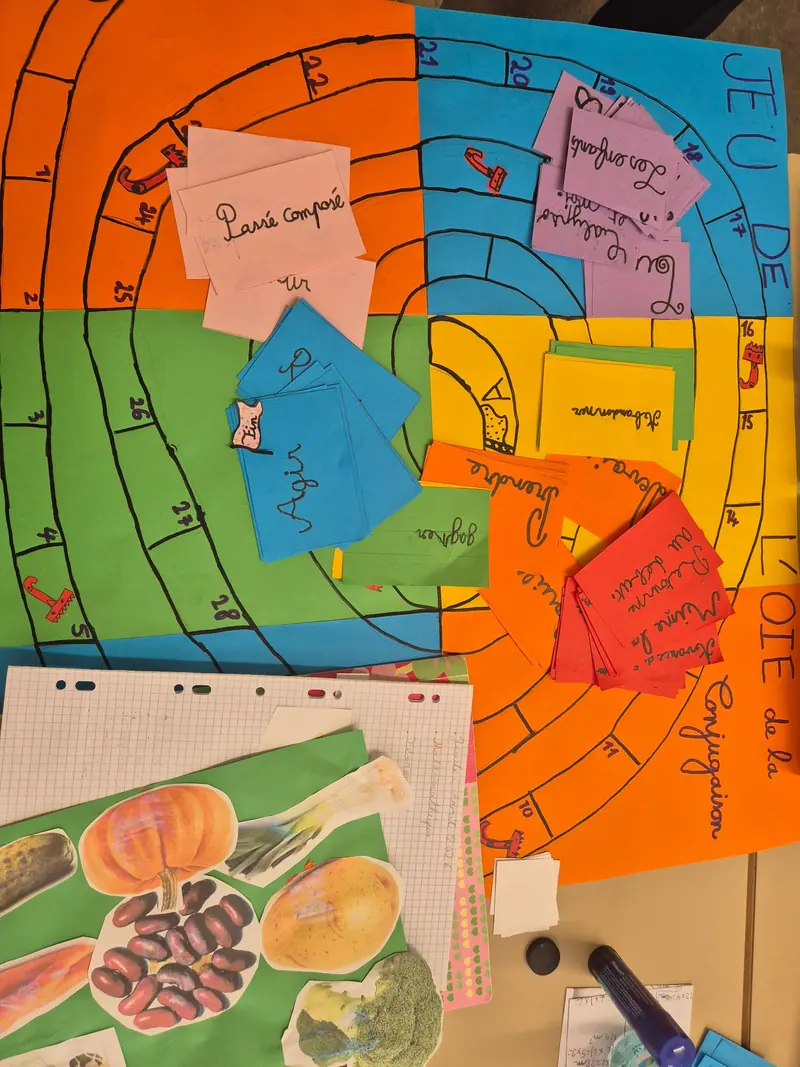
The languages are used in different contexts, with different people, for different activities. A child might, for example:
- speak French with their parents;
- speak English with their teacher;
- play in English with some classmates;
- watch cartoons in both languages;
- hear one language at home and the other at school.
Their brain therefore has to learn to move constantly between several language systems. That takes adjustment.
But adjustment does not mean confusion.
Why might a child mix languages?
Imagine a French-English child who knows the English word “water” but cannot immediately find the French word “eau”. They might say:
“Je veux water.” (I want water.)
Have they forgotten their French? Not necessarily. They may simply reach the English word faster in that particular context.
In a child regularly exposed to both languages, vocabulary is not always spread equally between the two. A word can be much more familiar in one language than in the other.
This is especially visible when the two languages are used in different settings. A child may know animal vocabulary perfectly in English because they learned it through stories and games in that language, while knowing more words about family or home in French.
Their total vocabulary can therefore be much richer than what you would measure by looking at one language alone.
“They’re mixing languages”: should you correct it straight away?
Not necessarily. When a child says:
“Maman, regarde, il y a un big dog !” (Mum, look, there’s a big dog!)
the reflex might be to answer: “No, we say ‘un gros chien’.”
But turning every sentence into a correction exercise can quickly make communication feel artificial. The child is trying, above all, to communicate.
It can be more helpful to rephrase naturally: “Oui, regarde, un gros chien !” (Yes, look, a big dog!)
The child then hears the French word in a meaningful context, without the conversation becoming a constant test.
The aim is not to let the child speak forever in a rough mix of both languages. The aim is to help them gradually build solid skills in two languages.
Mixing languages can also be strategic
There is an important difference between not knowing which language to speak and deliberately using the language resource that comes most easily.
A child growing up with two languages can understand perfectly well that one person speaks French and another speaks English, while still sometimes using elements of both in their own speech.
Context plays a huge role. The child gradually learns:
- who speaks which language;
- in which setting to use which language;
- which words belong to which context;
- how to adapt their language to the person they are talking to.
This ability to adapt becomes particularly important when the child is genuinely immersed in both languages.
The real issue: exposure
So the most interesting question is not “Will my child mix up the languages?”, but rather: “Does my child have enough opportunities to use each of the two languages?”
It is an essential distinction. A few hours of English a week do not create the same language environment as regularly using English to communicate, play, learn and interact.
A language becomes a tool when the child can really use it. It is no longer just about memorising words. The child needs to be able to:
- understand instructions;
- ask a question;
- tell a story;
- solve a problem;
- play;
- negotiate with another child;
- explain what they think;
- listen to a story;
- react spontaneously.
It is this repeated use, in context, that gives a language depth. We look at this difference in detail in Bilingual immersion or English lessons: what difference for a child?
Should each parent speak one language at home?
There is no single method that works for every family.
Some families use a different language with each parent. Others mainly use French at home and English at school. Others naturally use both languages depending on the situation.
What matters most is that the child gets regular and rich enough exposure to develop each language.
Parents do not need to turn their home into a language laboratory. A natural conversation, a story, a game, a song or a shared moment can be far more valuable than a string of artificial exercises.
What if the child always answers in French?
This situation can worry parents.
A child can understand a lot of English before being able to use it spontaneously with the same ease. So they may answer in French to a question asked in English. That does not necessarily mean they have not understood.
Look at the whole picture:
- do they understand instructions?
- can they follow a conversation?
- do they react to questions?
- do they recognise vocabulary?
- do they take part in activities?
- are they starting to produce English?
Language development is not just a matter of counting the sentences a child says. Understanding often comes before the ability to speak spontaneously.
Bilingual does not mean two identical languages
This is an important idea to let go of.
A bilingual child does not necessarily have exactly the same level in both languages. They may be more at ease in French when telling a story, and more at ease in English when talking about something they did at school.
Their level can also change with their environment. A language that becomes less present for a few months can temporarily lose ground, then progress again when exposure increases.
Bilingualism is something alive. It is not a straight line.
When should you really start asking questions?
Occasional mixing of languages is not, on its own, a warning sign.
On the other hand, when a significant difficulty appears in both languages, it may be worth talking to a professional to understand what is really going on.
This distinction matters. A difficulty linked to a language still being acquired is not the same as a general language difficulty.
So two extremes are best avoided: “They mix languages, so bilingualism is a problem for them”, and “They’re bilingual, so every difficulty must be normal”.
Observing the child as a whole remains essential.
What genuine bilingual education should offer
A bilingual school should not simply add a few hours of English to an essentially French programme.
The central question is rather: what does the child actually do with the language?
Do they use it only during a lesson? Or can they gradually:
- listen;
- understand;
- interact;
- play;
- learn;
- research;
- experiment;
- explain;
- cooperate?
This is where the link between bilingualism and active learning becomes particularly interesting.
When a child uses English to do something that makes sense to them, the language becomes a means of action. They are no longer simply trying to “learn English”. They use English to learn, communicate and act.
At Da Vinci Private School, language is a tool before it is a subject
At Da Vinci Private School, bilingualism is part of an approach in which children are regularly led to understand, communicate, experiment and take part.
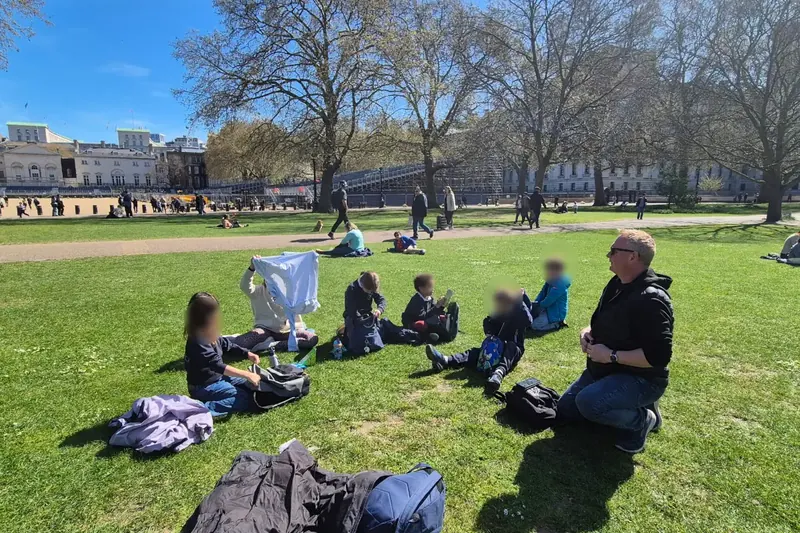
Rather than asking a child to produce a perfect language artificially, give them plenty of chances to use it in real situations suited to their age.
That is also why the quality of the language environment matters as much as the number of hours printed in a brochure. A language becomes familiar when it is part of the child’s daily life.
Discover our bilingual pre-school and our bilingual primary school.
So, will the two languages inevitably “mix”?
Yes, a child may sometimes use both languages in the same sentence. Yes, they may look for a word in one language and find it faster in the other. Yes, there may be periods when they seem to favour one language.
But that does not automatically mean they are lost between the two.
Bilingualism asks the brain to manage two language systems that interact. The real aim is therefore not to keep two languages perfectly sealed off from each other. It is to help the child become able to understand, think, communicate and act in two languages.
Key points
- Occasionally mixing two languages does not necessarily mean confusing them.
- A bilingual child’s vocabulary can be spread differently across their two languages.
- Understanding can come before speaking.
- Regular, rich exposure matters more than simply piling up lessons.
- The context in which a language is used plays an essential role.
- Genuine bilingual education lets the child use the language to communicate and learn, not just memorise vocabulary.
- If there is a significant difficulty in both languages, professional advice can help.
Bilingualism is not a balancing act in which the child must keep two languages in two perfectly separate boxes. It is rather learning to live with two ways of understanding and communicating with the world.
Ready to discover the Cocon d'Évolution?
The micro-campus welcomes 45 children in total. Take the time to talk with us and see whether the school is right for your child.
Apply for Admission