


Becoming bilingual: a real strength
At what age should a child start learning English?
7 April 2026
“Is it too early for my child to learn English?”
Many parents ask themselves this question.
In pre-school, some children already start hearing a second language. Others discover it a few years later, at primary school. Some parents hesitate to introduce English very early for fear of disrupting their child’s French.
So what really is the right age to start?
The answer is less simple than a number.
There is no magic age at which a child suddenly becomes ready to learn a foreign language. On the other hand, age, how often the child is exposed to the language, the quality of the language environment and the way the language is introduced can all make a real difference.
Can a child learn English from pre-school?
Yes.
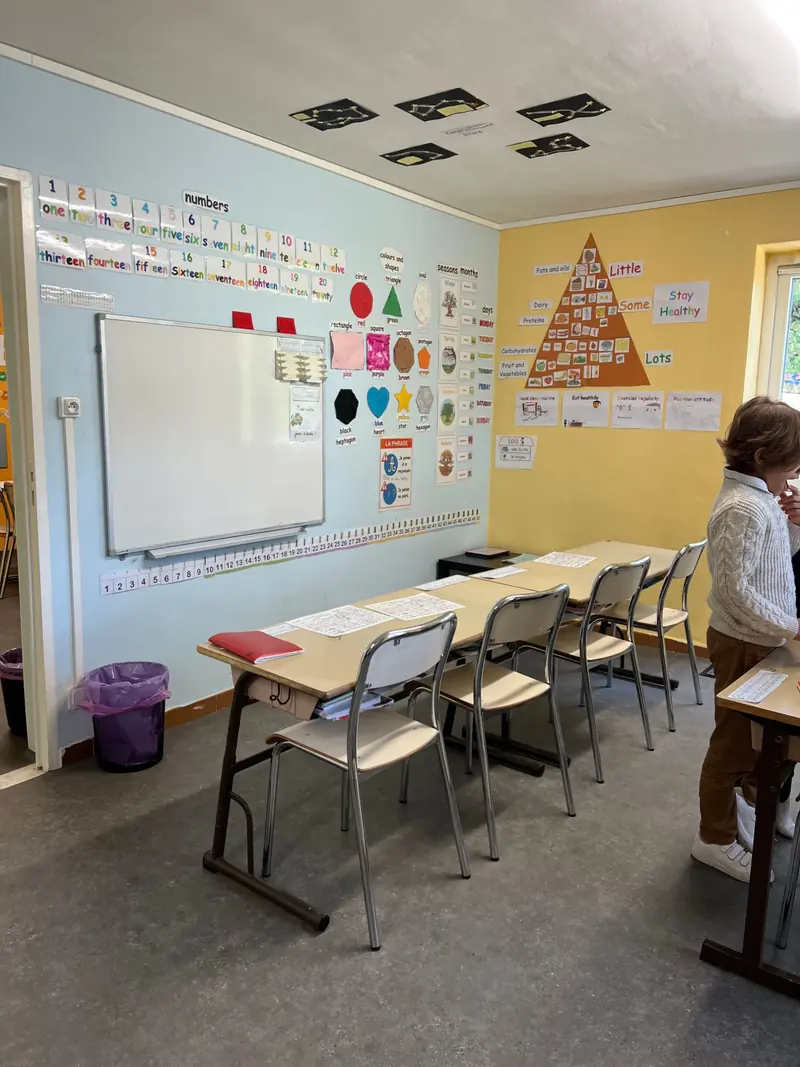
A young child can be exposed to a foreign language from the first years of life.
At this age, learning happens largely through listening, interaction, games, stories, songs, gestures and everyday situations.
The child does not need to know any grammar to start building an understanding of the language. They can gradually learn to recognise:
- sounds;
- words;
- expressions;
- instructions;
- intonation;
- repeated structures.
At first, progress can be hard to measure. A child may understand far more English than they speak. They may also stay silent for a while before starting to use certain words or expressions spontaneously.
That does not necessarily mean they are not learning.
Why are the early years so interesting?
Young children are particularly sensitive to the sounds of the languages around them.
When a language is heard regularly, the child can gradually become familiar with:
- its musicality;
- its rhythms;
- its sounds;
- its intonation;
- its everyday expressions.
This familiarity can then make understanding and speaking easier.
But beware of an all-too-appealing idea: starting very early does not automatically guarantee a better level.
A child who hears English for a few minutes a week will not necessarily have a big advantage over a child who starts later in a much richer environment.
Age matters. But the quality and regularity of exposure matter enormously too.
Does exposure matter more than starting age?
In practice, it is more useful to think in terms of language environment than in terms of age alone.
Compare two situations:
- Child A starts English at 3 but hardly ever hears it outside a short weekly activity.
- Child B starts at 6 but then benefits from regular exposure, frequent interaction and real opportunities to use the language.
Starting age alone cannot tell you which one will progress faster.
That is why the question “At what age should we start?” is worth completing with: “How much time will the child really spend hearing and using English?”
Hearing a language and speaking it are two different things
This point sometimes worries parents.
A child can be exposed to English for several months without saying much. That can be perfectly consistent with learning taking place.
Understanding often comes before speaking. The child listens. They observe. They memorise expressions. They understand certain situations.
Then, gradually, they start to speak. First perhaps a single word. Then two. Then a whole expression.
What matters is to give them enough situations in which they can use the language, without turning every attempt to speak into a school exercise.
Should a child learn to read in French before learning English?
No.
A child does not need to master reading and writing in French perfectly before being exposed to English. The two can develop side by side.
With young children, much of language learning can in any case be oral. Stories, songs, games, conversations and everyday activities expose the child to the language without going straight to reading and writing.
This can be particularly well suited to pre-school.
What if the child already learns two languages at home?
In a bilingual or multilingual family, the situation is different again.
The child may naturally hear several languages depending on the people, places or situations. The key is then to understand how each language is used day to day.
A child may well have a larger vocabulary in one language and different vocabulary in another. That does not necessarily mean they have not mastered the language.
Vocabulary also depends on the situations in which each language is used. A child might, for example, know many school-related words in French and more words about family life in another language.
Can a child confuse the two languages?
Occasional mixing can happen. A bilingual child may start a sentence in one language and use a word from the other.
This can be surprising. But it should not automatically be seen as a sign of confusion.
Bilingual children use whatever language resources they have to communicate. As their command of each language grows, they generally become better able to adapt their language to the person they are talking to and to the context.
What matters is the overall development of their skills, not a single sentence. We devote a whole article to this: Can a child learn two languages without mixing them up?
Should we speak English at home?
Not necessarily.
If parents are completely comfortable in English, they can of course use it with their child.
But there is no need to turn the home artificially into an English-speaking environment if that makes conversations difficult or forced.
A French-speaking parent who tries to speak English all the time without feeling at ease can sometimes create a less natural experience than a rich, warm conversation in French, combined with other regular opportunities to hear English.
Home can simply complement school with:
- stories;
- songs;
- books;
- games;
- age-appropriate films or cartoons;
- simple conversations;
- meeting English speakers.
English lessons or immersion?
This is where the question of age meets the question of environment.
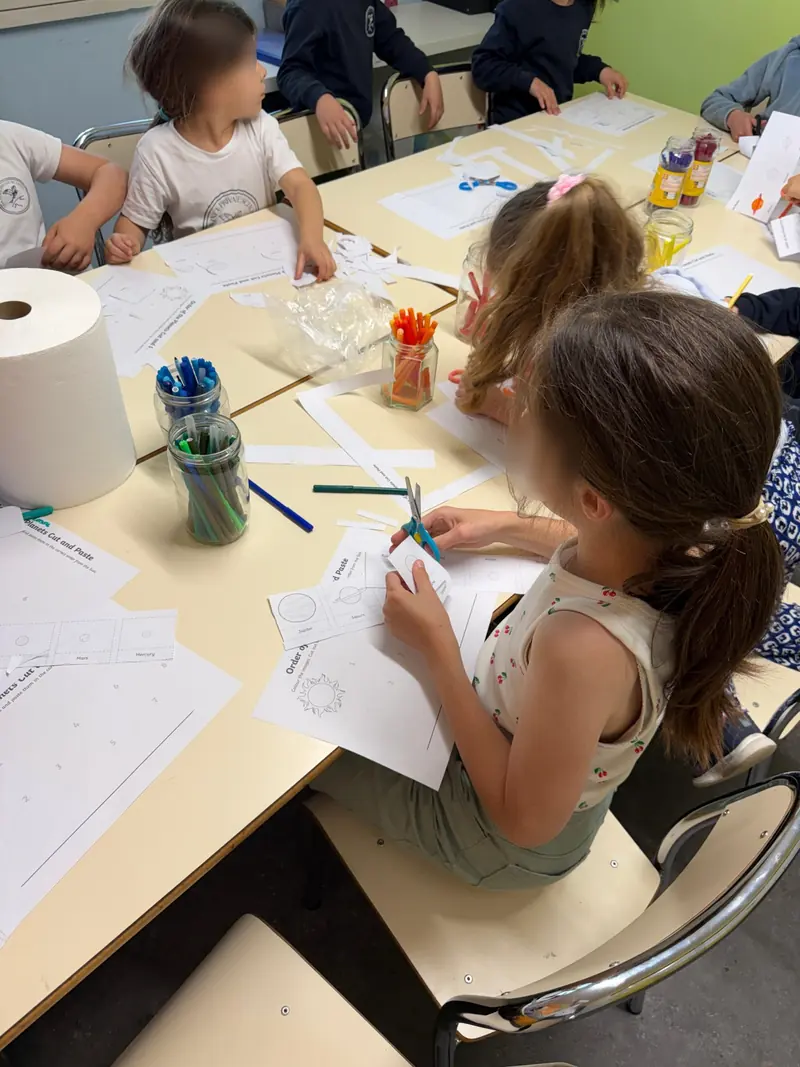
A pre-school child can discover English through a weekly activity. They can also grow up in an environment where English is used every day to communicate and learn.
These two experiences are not equivalent.
In the first case, the child meets English mainly during time set aside for the language. In the second, English can become a working language. The child can use it to:
- understand instructions;
- listen to a story;
- take part in an activity;
- play;
- work with other children;
- explore a topic;
- present something.
How often and in what context the language is used then changes considerably. To go further: Bilingual immersion or English lessons: what difference for a child?
Is bilingual immersion always better?
Here again, beware of answers that are too simple.
Bilingual immersion can offer a great deal of exposure. But the word “immersion” alone does not guarantee the quality of a programme.
Parents should look in particular at:
- the real proportion of French and English;
- how often each language is used;
- the teachers’ language level;
- how much room is given to speaking;
- how beginners are supported;
- how progress is assessed;
- which subjects or activities take place in each language.
Two schools that both call themselves “bilingual” can therefore offer very different experiences.
At what age should a child start to get a good accent?
Early exposure can help a child become familiar with the sounds of a language.
But here too, avoid the simplistic promise: “Start before 5 and your child is bound to have a perfect accent.”
It is not that mechanical. Pronunciation depends, among other things, on the amount and quality of exposure, interaction with competent speakers and regular practice.
Starting early can create favourable conditions. It is not a guarantee.
What if my child starts English at 7, 8 or 10?
It is certainly not too late.
Young children may have some advantages in learning sounds and in weaving a language into daily life. But older children have other resources. They can, for example:
- understand more complex ideas;
- think consciously about the structure of a language;
- compare languages;
- use learning strategies;
- draw on what they already know.
So starting age should not become a race against the clock. Starting later does not mean a child cannot reach a very good level.
What really matters
If you are thinking about English for your child, five questions are probably more useful than the question of age alone.
1. How much English does the child really hear?
Occasional exposure and daily exposure do not create the same language environment.
2. Does the child really use the language?
Listening is important. But interacting is too.
3. Is the language linked to positive experiences?
A language can be learned in a context of curiosity, play, discovery and exchange.
4. Does the child get support suited to their age?
An effective programme for a 10-year-old does not necessarily look like one for a 3-year-old.
5. Is progress being followed?
Exposing the child to English is only half the job; the other half is watching what they understand and what they can do with the language.
The approach at Da Vinci Private School
At Da Vinci Private School, English is part of the school environment from the earliest age.
The aim is to let children develop their language skills through regular exposure and through real situations of communication and learning.
For young children, this means that English can be linked to stories, activities, interaction and discovery rather than simply memorising lists of vocabulary.
The idea is simple: make the language a tool the child uses, rather than just a subject to study.
This approach is part of a wider way of teaching that also sets out to develop curiosity, independence and the child’s ability to learn through experience. Discover our bilingual pre-school, from age 2.
So, what is the best age to start?
If we really had to answer in one sentence: there is no universal best age; the best moment is when the child can benefit from exposure that is suitable, regular and rich enough for the language to become familiar.
Starting early can be worthwhile. But starting early with very limited exposure is not necessarily more effective than starting a little later in a much richer environment.
Age is one factor among others.
The real question is not only “When should we start English?”, but: “What language environment can we give our child once we have started?”
That question lets us move beyond the race to start “as early as possible” and think about what really matters: regularity, the quality of interaction, the pleasure of learning and real opportunities to use the language.
Ready to discover the Cocon d'Évolution?
The micro-campus welcomes 45 children in total. Take the time to talk with us and see whether the school is right for your child.
Apply for Admission